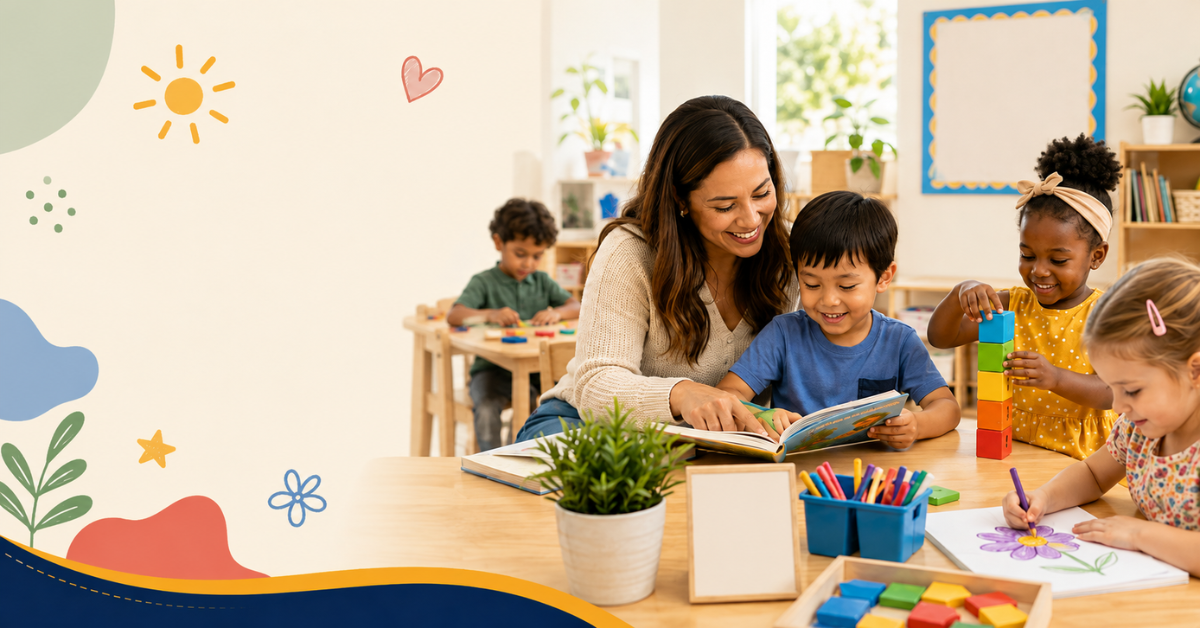
Walk into any preschool room and you’ll see children who are technically the same age and almost nothing alike. One four-year-old is already sounding out the letters on the cubbies. Another is still working out how to hold a marker without the whole fist. A third spent the first twenty minutes of the morning crying at drop-off and is only now ready to think about anything else.
Now picture a single lesson aimed at all of them at once. It’s going to fit maybe two or three kids well. The rest are either bored or lost, and at this age both of those feelings tend to stick. Preschool is where children form their very first opinion of themselves as learners. Get the fit wrong and a four-year-old can decide, quietly and years too early, that they’re just not good at this.
That’s the gap personalized learning is meant to close. Not by handing every child a tablet or a private tutor, but by meeting each one at the exact spot they’re standing and nudging from there.
What personalized learning actually means in a preschool room
The phrase gets used so much it’s started to lose its shape, so it’s worth being concrete. In an early-childhood setting, personalized learning is simply teaching that adjusts to the child instead of asking the child to adjust to the teaching.
That adjustment happens along a few different lines. The pace can change, so a child who needs longer with an idea actually gets it. The starting point can change, so two kids can work on the same skill from wherever each of them currently is. The kind of support can change, so one child gets a hint and another gets to try it cold. Same classroom, same broad goals, different rungs on the ladder.
What it is not is a child parked alone in front of a screen while an algorithm decides what comes next. In preschool, the personalizing is done by a person who knows the child, watching how they play and what trips them up, and quietly adjusting as they go.
Personalized doesn’t mean isolated
There’s a common worry that if every child is on their own path, the class stops being a class. In practice it’s closer to the opposite. Kids still build together, still argue over the good blocks, still sit for the same story. The personalizing shows up inside shared activities, not by pulling children off into separate corners. A four-year-old learns an enormous amount from watching a peer who’s one step ahead, and that only works if they’re in the room together.
Why the one-size-fits-all classroom leaves kids behind
The range inside a single preschool group is wider than most people expect. Two children born a few months apart can be developmentally close to a year apart, and that’s before you factor in temperament, home language, how much a child has been read to, or whether they’ve ever held a pair of scissors.
Teach to the middle of that range and you lose both ends. The child who’s ready for more gets a steady diet of things she already knows, and boredom in a preschooler doesn’t look like a bored adult quietly checking out. It looks like wandering off, poking a neighbor, or falling apart on the rug. Meanwhile the child who needs more time gets pushed past the point where anything is landing, and starts to link the whole business of learning with the feeling of being behind.
Neither of those kids is misbehaving or slow. They’ve just been handed the wrong-sized task. The behavior and the discouragement are symptoms of the mismatch, and both tend to disappear the moment the task fits.
How preschool teachers personalize without a tutor for every child
The obvious objection is practical. One teacher, fifteen or twenty children, no clones. How is any of this supposed to happen?
The honest answer is that good early-childhood teachers have been doing it for a long time, mostly through observation and a set of low-tech moves that don’t require a tutor per child. A skilled teacher spends a large part of the day watching, then uses what they see to adjust who works on what, and how hard it is.
A few of the everyday tools that make it work:
- Flexible small groups that get reshuffled often. A child might be in the “more practice with rhyming” group on Tuesday and the “ready for a harder puzzle” group on Thursday. The groups aren’t labels, and they aren’t permanent.
- One activity with several levels of challenge built in. The same tray of counting bears can be “sort these by color” for one child and “make two groups that come out even” for another.
- Choice within limits. Letting children pick between a handful of worthwhile activities means each one drifts toward what they’re ready to stretch on, and the teacher learns something from what they choose.
- Adjusting the help, not the goal. Sometimes personalizing a task is as small as asking a leading question, holding one end of the paper, or saying nothing at all so the child can wrestle with it themselves.
None of that needs special equipment. It needs a teacher who’s paying close attention and has enough room in the day to act on what they notice.
A Tuesday morning, three kids, one activity
Here’s what this looks like when it’s working, using an ordinary moment instead of a theory.
The class is building with blocks. To an outside observer it’s just kids stacking, but three different things are going on. Maya has built the same flat road she builds every day, so the teacher crouches down and asks what would happen if a car needed to get over a river, which is enough to nudge her toward her first bridge. Across the rug, Sam has tried a tower four times and it keeps toppling. Instead of fixing it for him, the teacher hands him one wider block for the base and lets him discover why it helps. Off to the side, Ana isn’t building at all yet. She’s watching, and that’s fine, because watching is how she’s deciding it’s safe to join.
Same fifteen minutes, same box of blocks, three completely different lessons. Nobody got a worksheet labeled with their level. The teacher just read each child and gave each one the next thing they needed. That’s the whole idea, and it’s far less exotic than the phrase makes it sound.
The bigger payoff is emotional, not academic
It’s tempting to judge all this by academic output, whether the child can count higher or recognize more letters by spring. Those gains are real, but they aren’t the main event. The deeper effect of getting the fit right is what it does to a child’s relationship with learning itself.
A child who is regularly handed tasks at the right level of hard gets to feel something specific and important: struggling a little, and then succeeding anyway. Do that enough times and a kid starts to believe, at a gut level, that effort pays off and that being stuck is temporary. That belief is worth more than any single skill, because it’s the engine behind every skill they’ll pick up later.
The reverse is just as powerful. A child who spends preschool feeling permanently behind, or permanently unchallenged and tuned out, learns a very different lesson about themselves. And those early self-concepts are stubborn. This is why personalization matters most at exactly this age. You’re not only teaching letters. You’re setting the thermostat for how a child approaches hard things for a long time afterward.
How the classroom itself does some of the work
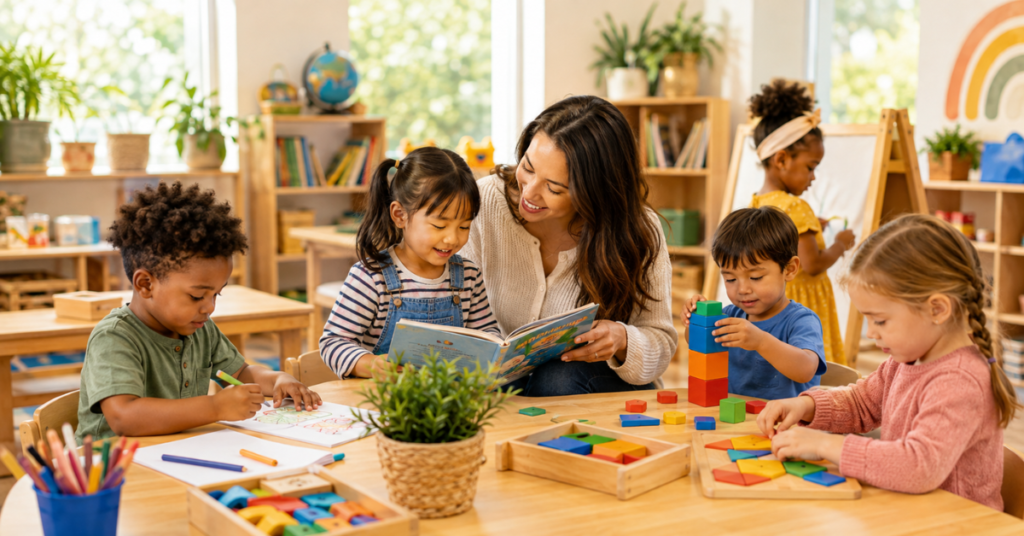
One thing that surprises people is how much of the personalizing gets handled by the room rather than the adult. A well-set-up early-childhood space is arranged so children can find their own level without a teacher standing over them.
Open-ended materials do a lot of this quietly. A basket of blocks, a pile of loose parts, a set of art supplies with no single right outcome, all of these meet a child wherever they are, because the child sets the difficulty by what they decide to make. The same few materials genuinely work for the child who’s ready for a lot and the child who needs it simple.
Self-correcting materials help too. Certain puzzles and manipulatives only fit together one way, so the material itself tells the child when something’s off, no adult required. That frees the teacher to spend their limited attention on the moments that actually need a human. When the environment is pulling its weight, personalizing twenty children at once stops sounding impossible and starts looking like a normal morning.
How parents can tell real personalization from a marketing phrase
Nearly every preschool now advertises that it personalizes learning, which makes the phrase close to useless when you’re choosing between programs. What matters is whether it’s actually happening in the room, and there are a few things you can look and listen for on a tour.
- Ask how teachers know where each child is. A real answer involves observation and specific examples, not a printed curriculum that every child marches through in lockstep.
- Watch whether children are all doing the same thing at the same moment. A room where twenty kids are on page four of the same packet is telling you something.
- Notice the range of activity happening at once. Genuine personalization is a little messy to look at, because different children are doing different things.
- Ask what happens when a child is ahead, and separately, what happens when a child needs more time. You want a program with a real answer to both, not just one.
- Pay attention to how staff talk about the kids. Teachers who personalize tend to describe children as individuals, with detail, rather than as a group they’re managing.
You don’t need a checklist of jargon. If the adults can talk specifically about your specific child after only a short visit, that tells you more than any brochure.
Bringing it back to the child
Strip away the terminology and personalized learning comes down to something ordinary: noticing each child and responding to what you notice. It doesn’t require expensive technology or a separate plan for every hour. It requires attention, a bit of flexibility, and a classroom set up to allow both.
That distinction is going to matter more, not less, in the next few years. As programs feel pressure to look rigorous and to lean on apps and standardized materials, there’s a real risk of “personalized” turning into a feature you buy rather than a thing teachers do. The preschools worth choosing will be the ones that keep it human, that treat personalization as the daily practice of seeing a child clearly and meeting them where they are.
Do that in the early years and you give a child more than a head start on letters and numbers. You give them the sense that learning is something they’re good at, and something that tends to go their way when they try. That’s the one advantage that keeps paying off long after preschool is over.
Frequently asked questions
Is personalized learning just letting kids do whatever they want?
No. There’s still structure, a plan, and clear goals for what children should be growing toward. The personalizing is in how each child gets there, not in dropping the destination. Choice is offered inside boundaries the teacher sets, and an adult is steering the whole time.
How is this different from what any good preschool teacher already does?
In a lot of ways it isn’t, and that’s the point. Skilled early-childhood teachers have always adjusted to individual children. The term just names that practice and treats it as the core of the job rather than a bonus. What separates programs is how deliberate and consistent they are about it.
Does my child have to be gifted or struggling to benefit?
No. Every child, including the one who seems perfectly on track, learns better when the task fits. The child in the middle is often the one most likely to get overlooked in a one-size-fits-all setup, precisely because nothing about them is raising a flag.
Can personalized learning work in a play-based program, or only an academic one?
It fits play-based settings especially well. Play is naturally personalized, because children at play will self-select the level that challenges them. A good play-based teacher uses those moments to meet each child, so the two approaches reinforce each other instead of competing.
Does personalized learning require expensive technology?
No. For this age it’s mostly low-tech: observation, flexible grouping, open-ended materials, and a teacher with enough time and attention to act on what they see. Screens and apps aren’t necessary, and for young children they usually aren’t the point.