Young children are learning vocabulary, letters, numbers, routines, self-control, and social skills at the same time. The challenge is not simply presenting information. It is presenting it in a form a child can notice, understand, remember, and enjoy.
Music can help. A short song can turn a multi-step direction into something memorable. A steady beat can make syllables easier to hear. Movement can make counting and positional words more concrete. Even a familiar cleanup song can reduce repeated verbal prompting.
Music is most useful when it has a purpose. It should not replace conversation, books, hands-on exploration, or direct teaching. Instead, it can be one of several engaging tools that help children connect with a concept. That fits naturally with RARE Learning’s curriculum philosophy, which emphasizes varied approaches, enjoyable learning experiences, individual guidance and parent involvement.
Music Gives Young Children a Pattern They Can Follow
For a preschooler, a spoken explanation can disappear quickly. Music adds structure. Rhythm creates a predictable sequence, while melody gives words a recognizable shape.
Compare saying, “Put the blocks in the bin, place the books on the shelf, then come to the rug,” with singing the same steps to a simple tune. The information is identical, but the child now has a pattern to follow.
This can be especially useful for information that comes in order: counting, the alphabet, days of the week, classroom steps, and simple sequences. The goal is not to turn every lesson into a song. It is to use musical patterns when they make an idea easier to organize and remember.
Songs Can Strengthen Early Language Skills
Music and language both depend on listening to differences in sound, pace, stress, and sequence. Songs also repeat words naturally, giving children several chances to hear and use language without making the experience feel like a drill. Music, rhymes, and active listening can support important early language and literacy experiences.
Rhythm Makes the Parts of Words Easier to Notice
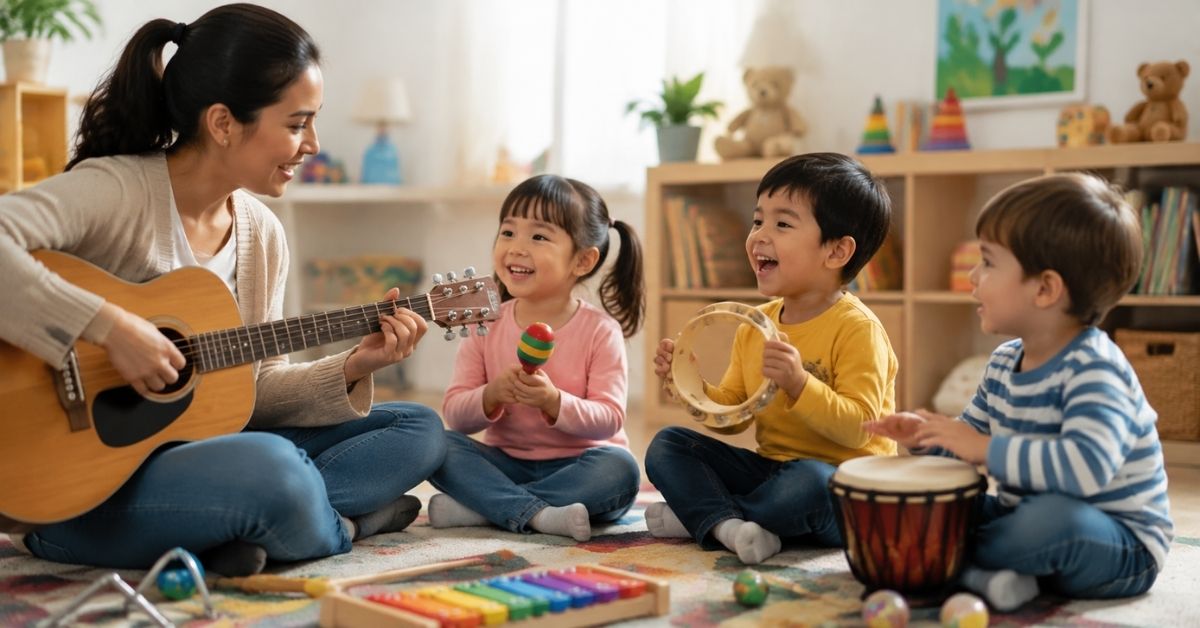
Clapping names, tapping syllables, and chanting rhyming words draw attention to how language sounds. A teacher might clap “but-ter-fly” in three beats or ask children to find a word that rhymes with “cat.”
These playful moments help children become more aware of the sounds inside words an important skill as they begin connecting spoken language with letters.
Songs Can Introduce Useful Vocabulary
A weather song might include words such as “drizzle,” “stormy,” “cloudy,” and “breeze.” A movement song can introduce “under,” “over,” “beside,” “slowly,” and “quickly.”
Adults can strengthen the lesson by explaining unfamiliar words, using gestures, and bringing the vocabulary into later conversation. Instead of expecting a song to teach a word by itself, teachers and parents can use the song as the starting point for meaningful discussion and play.
Music and Movement Make Ideas More Concrete
Young children often understand concepts more easily when they can act on them. Music gives them a natural reason to move while listening.
A body-part song connects spoken labels with physical locations. A freeze game asks children to move, listen for a signal, stop, and restart. A counting song can ask for five jumps, three claps, or two turns.
Music-and-movement activities can support:
- Counting and one-to-one actions
- Body and positional vocabulary
- Fast/slow and high/low concepts
- Following directions
- Simple sequences
- Listening before responding
They also offer another way to participate. A child who is not ready to answer aloud may show understanding through a gesture, beat, or movement. Songs that combine words with actions are commonly used in early childhood settings to strengthen listening, language, and direction-following skills.
Familiar Songs Can Make Daily Routines Smoother
Some of the hardest preschool moments are transitions: cleaning up, washing hands, lining up, moving from play to a small group, or getting ready to go home.
A consistent musical cue can tell children what is happening next without a long stream of instructions. A brief cleanup song, for example, can become a predictable signal that playtime is ending. Similar cues can support handwashing, putting materials away, greeting classmates, and preparing for story time.
Predictable songs and sounds are especially useful during transitions because they give children a recognizable cue about what comes next.
This matters for early learning programs because smoother transitions protect learning time. Teachers spend less energy repeating directions, and children experience a day that feels more predictable.
Music Can Support Attention But More Is Not Always Better
Music can sharpen attention when children need to respond to it. Call-and-response songs require listening for a turn. Start-and-stop games ask children to control an action. Rhythm-copying games encourage children to listen before responding.
These activities practice useful learning behaviors: paying attention, holding a short direction in mind, waiting, shifting between actions, and controlling an impulse. Music-and-movement experiences can also provide opportunities to practice self-regulation and school-readiness behaviors.
But constant background music can work against the lesson. Music with lyrics may compete with stories, new vocabulary, or other language-heavy activities. Evidence examining background music has found that lyrics can interfere with verbal memory and reading-related tasks.
A practical rule is simple: use music when children are meant to engage with it; reduce it when they need to focus closely on other language.
How Teachers Can Use Music Effectively
Using music in preschool does not require expensive instruments or a trained singing voice. Simple, repeated experiences are often the easiest to use consistently.
- Give each song a job. Use it for counting, movement, vocabulary, or a specific transition.
- Keep learning songs short. Simple phrases and clear repetition make participation easier.
- Make children active participants. Invite clapping, tapping, echoing, moving, or finishing a familiar line.
- Connect songs to real objects and actions. Count blocks after a counting song or point to body parts during a movement song.
- Repeat before adding complexity. Once children know the pattern, change a word, number, movement, or verse.
- Build in quiet. Follow energetic music with a clear shift into reading, conversation, or hands-on work.
- Include family and cultural music. Familiar songs from home can create connection while broadening the group’s listening experiences.
Simple Ways Parents Can Extend Musical Learning at Home
Parents do not need to recreate a classroom. Short musical moments can fit naturally into daily routines.
- Sing a handwashing or cleanup song.
- Clap the syllables in family members’ names.
- Make a counting chant while putting toys away.
- Pause before the final word of a familiar song and let the child finish it.
- Copy simple rhythms with hands, containers, or wooden spoons.
- Ask whether a sound was fast, slow, loud, or quiet.
- Invite the child to invent a verse about something that happened that day.
The interaction matters more than performance. When an adult responds to what a child notices, says, or creates, music becomes a shared learning experience rather than background entertainment. This also complements Rare Learning’s emphasis on parents helping children connect learning activities with their everyday environment.
The Best Use of Music Is Flexible
Not every child responds to music in the same way. One preschooler may love singing but dislike loud group music. Another may prefer tapping a beat to performing motions. A child who enjoys a movement song may still need silence during a puzzle or story.
Teachers can adjust the volume, length, complexity, group size, and way children participate. Singing, moving, tapping, choosing a picture or simply listening can all be valid ways to join.
The purpose is not to produce young musicians. It is to use an engaging medium to help children access language, math, routines, movement, creativity, and social participation in ways that feel manageable and meaningful.
Conclusion
Music can make learning easier for young children when it is used intentionally. A purposeful song can organize information, make language more noticeable, connect ideas with movement, smooth transitions, and give children an enjoyable way to practice attention and self-control.
Strong early learning environments offer more than one path into an idea. For preschools and families, music is especially useful because it is accessible: a voice, a beat, a rhyme, and a little movement can turn an ordinary moment into meaningful practice.
As early childhood programs continue to create more flexible and individualized learning experiences, music can remain a valuable tool because it adapts easily to different children, subjects, routines, and home environments. Used thoughtfully, music does not compete with learning. It helps children enter it.
FAQ
Does music help preschoolers remember information?
Yes. Rhythm, repetition, and melody can make short sequences, words, and routines easier to recall, especially when children actively participate.
What Types of Music Are Best for Young Children?
Simple songs with clear words, repetition, an easy beat, and age-appropriate content work well. The best choice depends on the activity and the child.
Should Music Play in the Background While Children Learn?
Not all the time. Background music can distract during stories, conversations, or language-heavy tasks. Use music for a clear purpose, then create quiet for focused listening.
Can Music Help With Early Math Learning?
Yes. Counting songs, patterned clapping, repeated beats, and movement sequences can make number order, patterns, and one-to-one counting more concrete.
Do Parents Need Musical Skills to Use Music for Learning?
No. Simple singing, clapping, chanting, and movement are enough. Warm interaction and participation matter more than musical ability.