
A child does not suddenly become a reader or confident speaker when kindergarten begins. Long before formal reading instruction, children are learning how words sound, what they mean, how conversations work, and how stories fit together.
The challenge for many parents is knowing how to support those skills without turning the preschool years into a series of lessons and worksheets. Fortunately, early literacy does not require complicated activities. Some of the most valuable opportunities happen while preparing breakfast, driving to preschool, playing with toys or sharing a bedtime story.
Speaking and early reading also develop together. As children become better at understanding and using language, they build a stronger foundation for later reading and writing. The goal, therefore, is not to make a preschooler read as early as possible. It is to create an environment where books, words, questions, and conversations feel interesting and enjoyable.
Early Reading Begins With Conversation
Before children can understand sentences on a page, they need experience understanding sentences in everyday life. Conversations introduce vocabulary, teach children how ideas connect, and give them opportunities to organize their own thoughts.
Even very young children participate in communication before they can speak clearly. A baby may point, babble, smile, or reach for something; an adult responds with words and attention. These back-and-forth exchanges help children develop language, social communication, and the ability to participate in longer interactions.
Parents can encourage this naturally by treating a child’s sounds, gestures, and short phrases as meaningful communication. When a toddler points at a truck and says, “Truck,” a parent might respond, “Yes, that’s a big red truck. It’s carrying dirt.”
The child contributed one word, but the adult modeled a richer sentence without demanding repetition.
Turn Everyday Routines Into Language Practice
Families do not need to schedule a separate “speaking lesson.” Daily routines already contain hundreds of useful opportunities to introduce language.
Describe What Is Happening
Talk about ordinary actions as they happen: “I’m cutting the apple into slices,” or “Your shoes are wet because we walked through the puddle.”
This gives children words connected to something they can see, touch, or experience. ASHA recommends talking about what adults and children are doing and gradually using longer sentences as a child’s language develops.
Specific words are especially useful. Instead of always saying, “Look at that animal,” say, “Look at that squirrel climbing the tree.” Children learn vocabulary more easily when words have a clear purpose and context.
Expand Instead of Constantly Correcting
When children are learning to speak, their sentences will not always be complete or grammatically correct. Rather than stopping the conversation to correct every mistake, model the fuller version naturally.
If a child says, “Dog run,” you might answer, “Yes, the dog is running really fast.”
The conversation continues, and the child hears a more complete language pattern. ASHA similarly advises adults not to interrupt young children simply to correct speech sounds; adults can instead pronounce words correctly in their own responses.
Read With Your Child, Not Just to Your Child
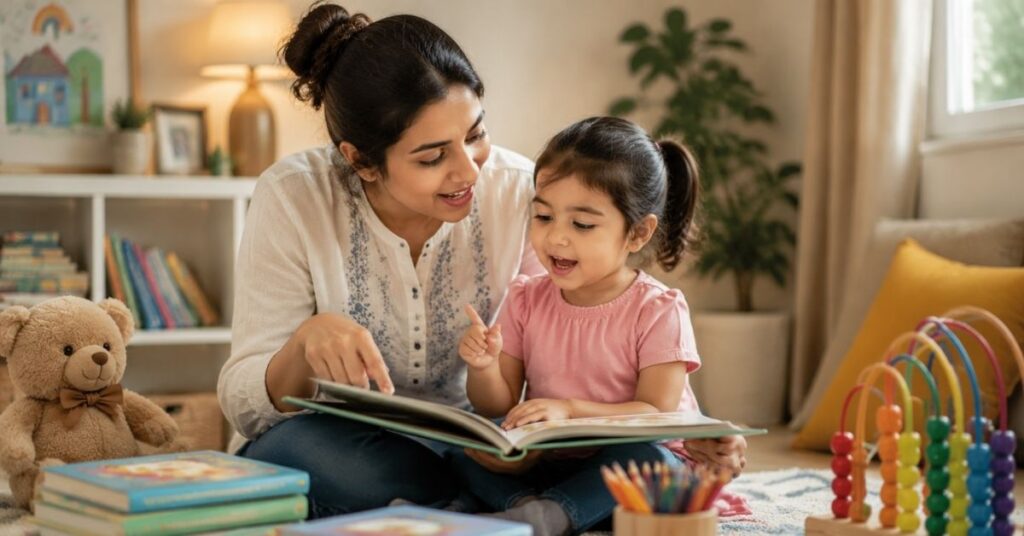
Reading aloud is valuable, but shared reading becomes even more powerful when children participate.
Instead of focusing on finishing every sentence on every page, stop occasionally and talk about the story. Preschool children can discuss pictures, ask questions, connect stories with their own experiences, and eventually retell familiar stories in their own words.
Turn the Story Into a Conversation
Useful prompts include:
- “What do you think will happen next?”
- “Why do you think she looks worried?”
- “Can you find the yellow bird?”
- “What would you do if that happened to you?”
- “Can you tell me what happened in this picture?”
Questions like these encourage children to explain rather than simply identify the “right answer.”
Children should also be allowed to ask questions, change the subject briefly, or spend extra time examining an interesting picture. The interaction matters more than getting through the book quickly.
Do Not Worry About Reading the Same Book Again
Adults may become tired of a familiar story long before children do. For a preschooler, however, repetition creates opportunities to notice new details, remember phrases, predict what comes next, and eventually pretend to read parts of the story independently.
Toddlers can begin naming familiar pictures and completing phrases from favorite books, while preschoolers may retell well-known stories in their own words.
Build Vocabulary Through Play and Real Experiences
Children need more than definitions. They understand words more deeply when they can connect them with actions, objects, emotions, and experiences.
Imagine a child pretending to run a grocery store. The activity naturally introduces words such as basket, customer, cashier, receipt, expensive, and change. Building with blocks can lead to words such as balance, taller, underneath, corner, and collapse.
Adults can participate without taking control. Ask, “What are you building?” or “How can we make the tower stronger?” The child gets a reason to explain an idea, solve a problem, and use new language.
This kind of hands-on, varied learning also fits RARE Learning’s curriculum philosophy, which emphasizes engaging children through different tools, interests, activities, and individualized guidance rather than relying on one way of teaching.
Use Songs, Rhymes, and Word Games
Language does not always have to come through books. Songs, nursery rhymes, clapping games, and silly word play help children pay attention to how language sounds.
Try stretching out a rhyme during a car ride: “Cat, hat, bat…what else sounds like cat?” Or choose a sound and find objects around the house beginning with it.
The activity should stay playful. If a child loses interest, move on. The purpose is to make children curious about words and sounds, not to test how many answers they know.
Create a Home Environment That Invites Reading and Talking
A literacy-friendly home does not need shelves filled with expensive educational materials. It needs accessible opportunities for children to interact with language.
Keep a few books where children can reach them independently. Visit the public library and let your child select books. Put drawing materials within reach so early “writing” becomes part of play. Read signs during walks, talk about a grocery list, or let your child help identify their name on personal belongings.
Most importantly, protect some moments from unnecessary distraction. A five-minute conversation with real attention can be more valuable than an elaborate activity in which the adult is only half engaged.
Encourage Progress Without Pushing Formal Reading Too Soon
Children develop at different rates. One four-year-old may recognize many letters while another is more interested in telling elaborate stories or examining pictures. Development should not become a competition.
The American Academy of Pediatrics advises families not to push preschool children into reading before they are ready and emphasizes maintaining enthusiasm for learning rather than drilling letters and words.
Follow your child’s interests. A child fascinated by dinosaurs may happily explore dinosaur books. A child who loves cooking can help “read” a recipe by looking at pictures and identifying ingredients.
Families who speak more than one language should also feel comfortable using the languages they know best. Rich conversation in a familiar home language supports meaningful communication; ASHA specifically encourages families to communicate and read in the languages children are learning.
Connect Home Learning With the Preschool Experience
Early literacy becomes stronger when children encounter supportive language experiences both at home and in preschool.
Parents can ask teachers what stories, themes, vocabulary, or activities currently interest their child. Those ideas can then appear naturally at home. If the class is learning about plants, for example, the family might grow a small herb, read a gardening book, and talk about roots, stems, soil, and water.
For early-learning programs, this connection matters as well. Families are more likely to reinforce learning when they understand what their child is doing and why. RARE Learning’s philosophy places particular importance on parental involvement, individualized guidance, and communication about each child’s progress.
Know When a Child May Need Extra Support
Variation is normal, so one missed milestone does not automatically indicate a problem. However, parents should speak with their pediatrician when a child is missing several expected communication skills, stops developing new skills, or loses abilities they previously had. Hearing concerns can also affect language development and are worth discussing promptly.
Early support is not about labeling a child. It is about understanding what they need and making sure communication difficulties do not unnecessarily interfere with learning or participation.
Conclusion
Encouraging early reading and speaking skills is less about finding the perfect program or pushing children ahead and more about creating frequent opportunities to communicate.
Talk during routines. Expand on what your child says. Read familiar books together. Ask thoughtful questions. Sing, rhyme, pretend, explore, and give children enough time to respond.
Most importantly, keep language connected to curiosity and relationships. Children who experience words as tools for telling stories, asking questions, understanding their world, and connecting with other people have meaningful reasons to keep learning.
As children move toward kindergarten and beyond, those everyday experiences can grow naturally into more advanced reading, writing, and communication skills without sacrificing the enjoyment that made them interested in learning in the first place.
FAQs
What age should parents start encouraging early reading skills?
Parents can begin sharing books from infancy. Early reading experiences initially involve listening to voices, looking at pictures, handling books, pointing, and participating in simple interactions rather than actually reading words.
How can I help my toddler speak more?
Talk about everyday activities, respond to gestures and short phrases, expand your child’s sentences naturally, tell stories, read together, and ask questions that encourage more than a yes-or-no answer.
Should a four-year-old already know how to read?
Not necessarily. Preschool children develop reading readiness at different rates, and there is no need to force formal reading before a child is interested and ready. Maintaining curiosity and enjoyment is more important.
Is rereading the same children’s book helpful?
Yes. Familiar books allow children to anticipate phrases, notice details, name pictures, remember story sequences, and eventually retell parts of the story themselves.
Does speaking more than one language at home affect early language learning?
Families can confidently communicate in the languages they are most comfortable using. Children benefit from meaningful conversation and reading in the languages they are learning.