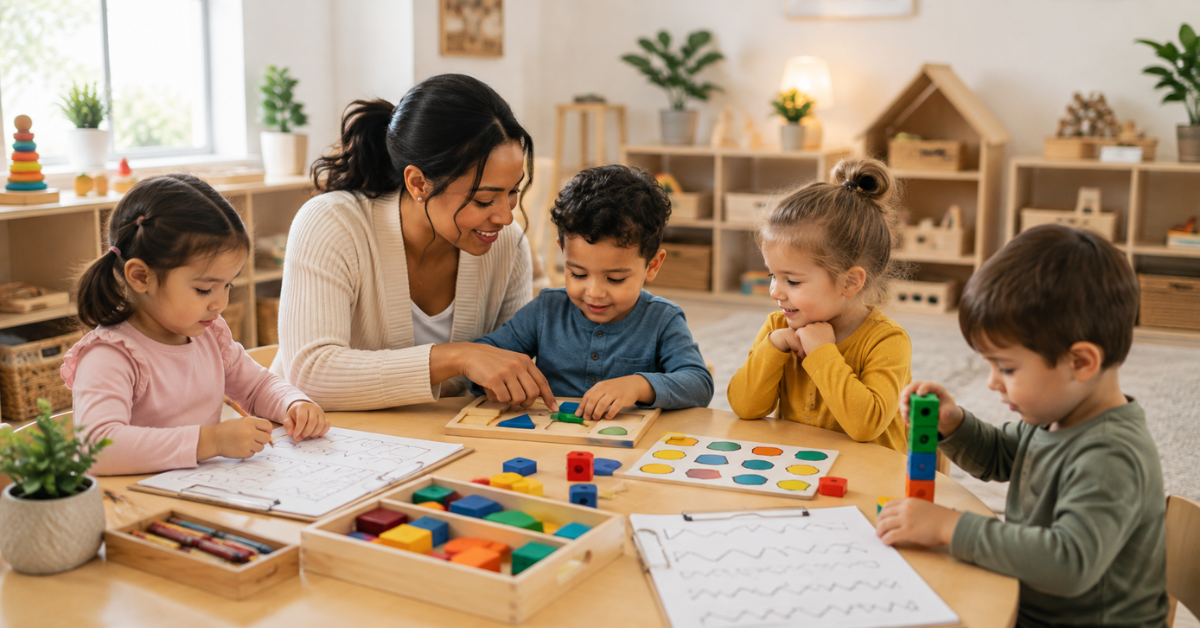
Walk into any room of four-year-olds and you can spot the problem in about thirty seconds. One child is sounding out the words on a book cover. Two seats over, another is still figuring out how to hold the pencil. They were born the same year, sometimes the same month, and they are in completely different places. Now picture teaching both of them the same lesson, at the same speed, in the same way. One is bored before you finish the sentence. The other is lost before you begin.
That gap is the reason individualized attention isn’t a nice extra in early education. It’s the thing that decides whether the early years turn into real growth or quietly get wasted. A good curriculum sets the direction, but attention is what makes it fit an actual child. This post is about why that fit matters so much this early, and what it looks like when it’s done well.
Same age, different stage
We group young children by age because it’s tidy, not because it tells us much. Age is an administrative decision. It says nothing about whether a child can sit with a hard task, whether they have the words to explain what they’re thinking, or whether their hands are ready for scissors.
Here’s the part people miss: the spread isn’t just from child to child. It shows up inside one child. A three-year-old can have the vocabulary of a five-year-old and the fine motor skills of a two-year-old at the same time. Development comes in lumpy, uneven bursts. So a classroom isn’t one line of kids you can move along together. It’s dozens of moving parts, and no two children have the same set.
When you teach the whole group as if they were the same, you’re teaching to an average that doesn’t actually describe anyone in the room.
What growth actually looks like before kindergarten
Ask a parent what academic progress looks like at this age and you’ll usually hear about letters, numbers, maybe the first words a child can read. Those matter. But they sit on top of a set of skills that don’t look academic at all, and those are the ones that really drive learning: staying with something when it stops being fun, asking a question instead of guessing, using language to work through a problem, controlling a pencil well enough that writing isn’t a wrestling match.
This is where individualized attention earns its keep. A child who “can’t do the worksheet” often doesn’t have a letter problem. They have a focus problem, or a fine motor problem, or they’ve decided they’re bad at this and stopped trying. Those need completely different responses. You only know which one you’re looking at if you’re watching that specific child closely enough to tell them apart.
Drilling more letters at a kid who has a persistence problem doesn’t build anything. It just teaches them that this stuff is unpleasant.
What individualized attention looks like day to day
It’s less dramatic than it sounds. Most of it happens in small moments a visitor would barely notice:
- Watching before stepping in. A teacher sees how a child approaches a puzzle before offering help, so the help fixes the real sticking point instead of a guess at it.
- Changing the door, not just the pace. Same skill, different way in. One child learns letter sounds through touch and tracing; another gets there through a song. Slowing down isn’t the only adjustment available.
- Catching the give-up moment. When a child is about to quit a task that’s almost within reach, the skill being taught is persistence. Coaching them through that wobble does more good over time than solving it for them.
- Using what a child already loves. A kid who can name forty dinosaurs can count to forty if the things being counted are dinosaurs. Interest carries the skill in on its back.
- Two-minute check-ins. A short one-on-one conversation often tells a teacher more about where a child is than any formal assessment.
Nearly all of this looks like play, which is exactly why it’s easy to undervalue. The work is real. It just doesn’t announce itself.
The part that never makes the report card
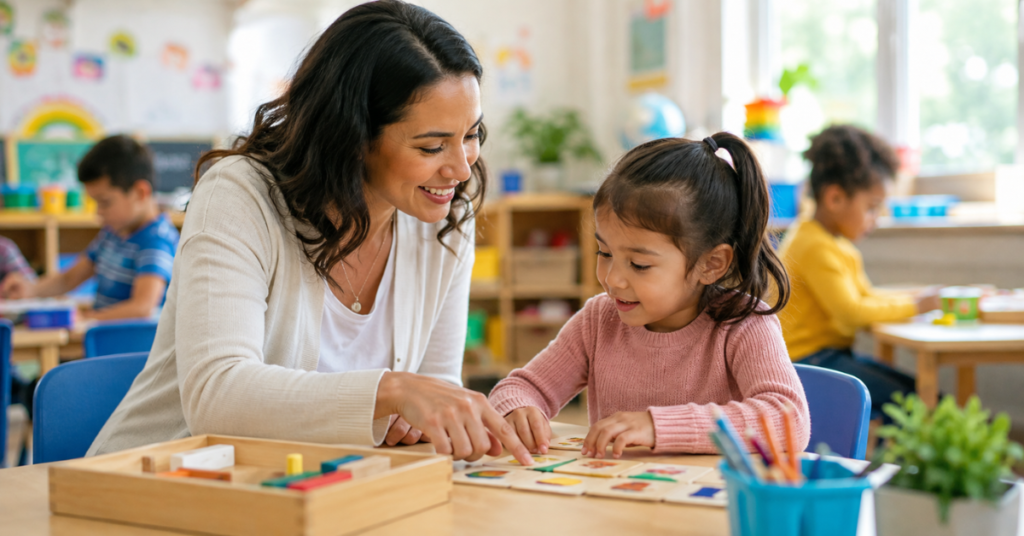
There’s a layer under all of this that’s hard to measure and easy to overlook. Young children learn from people they trust. A child who feels seen by the adult in front of them will take a risk, try the harder thing, admit they don’t understand. And risk is where nearly all real learning happens.
The reverse is just as true, and it’s the part that worries me. A child who feels like one more body in a crowded room plays it safe. They don’t ask the question. They copy the kid next to them. And somewhere in there, quietly, they start forming a belief about themselves and school. Those early beliefs are sticky. A four-year-old who decides “I’m not a reader” can carry that for years, long after the original difficulty could have been sorted out in a week.
So two children can get the identical lesson and walk away with opposite results, and the difference isn’t the lesson. It’s whether an adult was paying enough attention to make that child feel like their effort was worth something.
Why waiting is the expensive choice
Small differences at this age don’t stay small. A child who leaves preschool a little behind on language walks into kindergarten with less to build the next thing on, and since almost everything after that builds on what came before, the gap tends to widen on its own. Nobody has to do anything wrong for it to grow. It compounds.
The good news is that it compounds in the other direction too. A child who leaves the early years with solid footing and a bit of confidence finds the next thing easier, which builds more confidence, which makes the thing after that easier again. Momentum is doing the work either way. The only question is which direction it’s pointed.
That’s why the early years are the cheapest time to give a child individual attention. Every year you put it off, the gap is wider and the fix is harder. Attention that would take a month now can take a year later.
What individualized attention is not
The phrase gets used loosely, so it’s worth drawing some lines around what it doesn’t mean:
- It doesn’t just mean small classes. Ratios help, no argument. But a skilled teacher of eighteen who reads children well will individualize better than a distracted one with six. The skill is in the noticing, not only the numbers.
- It doesn’t mean letting a child only do what they’re already good at. That’s avoidance dressed up as personalization. Real individual attention is knowing when to stretch a child and when to steady them.
- It isn’t tutoring bolted onto a generic program. When it works, it’s built into how the room runs from the start, not sold as an upgrade.
- It isn’t the same as going faster. Some children need slower and deeper, not more and quicker. Speed is one setting, not the goal.
Get these wrong and “individualized” becomes a word on a brochure. Get them right and it changes what a child actually experiences all day.
The home side of the same work
Parents do a version of this constantly without calling it anything. You already know which activities your child drifts toward and which ones they’ll do almost anything to avoid, and that map is worth more than people think. The main thing is to resist finishing things for them. Letting a child struggle for a minute before you step in feels less kind in the moment, but solving the puzzle for them mostly teaches them to wait for rescue. It also helps to talk with them rather than at them: ask what they think will happen, why the tower fell over, where the story goes next. That back-and-forth is building the same language skills that surface later as reading and writing. And whatever your child is fixated on this month, counting or letters or patterns can usually ride in on the back of it.
When home and school read a child the same way, that child gets a consistent picture of themselves as someone who can work things out. A program that keeps parents in the loop about where their child is and what’s coming next makes that alignment much easier to reach.
The real work of the early years
The early years aren’t about front-loading academics or getting a jump on first grade. They’re about building the learner who’s going to do all of that later: a child who can focus, who isn’t scared of a hard problem, who trusts that effort gets them somewhere. Individual attention is the mechanism that builds that child, because you can’t grow those things in a person you haven’t bothered to look at closely.
Do it well and children arrive at kindergarten with more than a head start on letters. They arrive believing they can work things out, and that belief keeps paying off long after anyone remembers which four-year-old knew their alphabet first. That’s the part worth protecting, and it’s why individual attention belongs at the center of how we teach young children, not at the edges.
Frequently asked questions
At what age does individualized attention actually start to matter?
From the beginning, though it looks different at each stage. With babies and toddlers it’s mostly responsiveness: reacting to what a specific child is telling you. By preschool it starts shaping academic foundations directly, because that’s when the gaps in focus, language, and confidence begin to open up.
Does this mean my child needs one-on-one tutoring?
No. Individual attention is about the quality of attention a child gets, not a private teacher. A skilled educator in a group setting can meet a child where they are. Ratios matter, but they aren’t the whole story.
How can I tell if a program really individualizes or just says so?
Ask them about your child specifically. A program that means it can tell you roughly where your child is, what they’re working on next, and how they’d adjust if your child got stuck. If all you get is general talk about their approach, be a little skeptical.
Won’t focusing on individual needs hold back the kids who are ahead?
It’s the opposite. A single pace is exactly what bores the children who are ahead, because it’s set for the middle of the room. Paying attention to individuals means stretching those kids too, not parking them while everyone else catches up.
What’s the simplest thing I can do at home?
Stop finishing things for them. Let your child wrestle with a task a little longer than feels comfortable, and talk through it with them instead of taking over. That one habit builds focus and language at the same time.