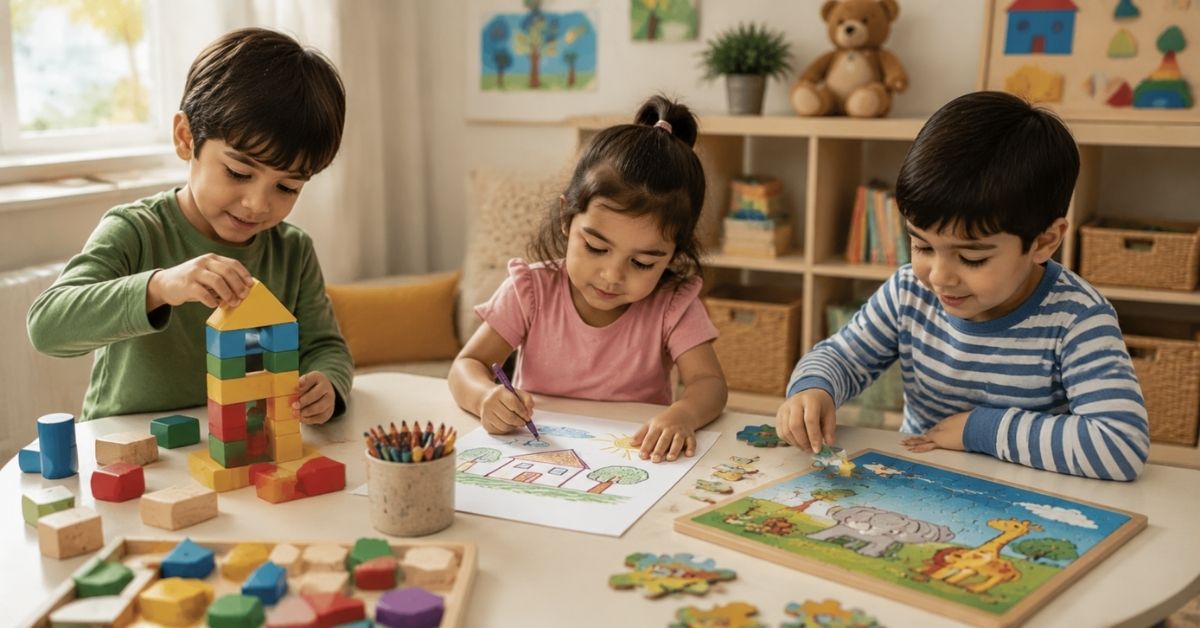
A preschooler stacking blocks, covering a page with circles or turning the same puzzle piece again and again may appear to be simply passing the time. In reality, these ordinary moments ask children to do something remarkably complex: form an idea test it with their hands, notice what happened and decide what to try next.
That is why hands-on activities deserve a meaningful place in early learning. Young children are still developing the coordination, attention, language, spatial awareness, and problem-solving habits they will eventually use for reading, writing, mathematics, science, and everyday independence. Play gives them a practical setting in which to develop those abilities together rather than one at a time. NAEYC identifies sustained play as an important way for young children to develop physical abilities, make sense of their surroundings, solve problems, interact with others, and practice emerging skills.
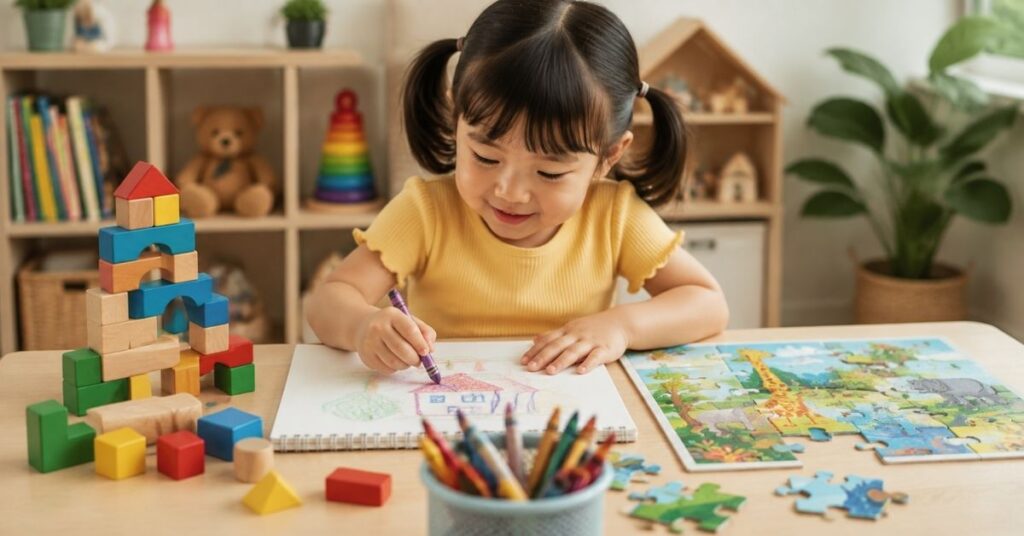
Building, drawing, and puzzles are especially useful because each activity asks children to think differently. Building turns ideas into three-dimensional structures. Drawing turns thoughts into visible symbols. Puzzles ask children to analyze an existing problem until the pieces make sense.
Together, they create the kind of active learning that children can see, touch, change, and understand.
Building Helps Children Understand How Things Work
Give a child a collection of blocks and the activity immediately becomes an experiment.
Can three small blocks support one large block? Why does a tall tower keep falling? How can two buildings be connected? What happens if the widest pieces go at the bottom?
The child does not need an explanation of engineering or geometry to begin exploring these questions. The materials provide immediate feedback. A structure either stands, leans, connects, balances, or falls.
Building Turns Mistakes Into Useful Information
One of the most valuable features of construction play is that failure is normal.
Imagine a four-year-old building a garage for toy cars. The roof collapses when a car is pushed underneath it. Instead of receiving a mark saying the answer is incorrect, the child can simply rebuild the supports, change the roof, or make the entrance wider.
That process develops an important habit: when the first solution does not work, change the solution rather than abandon the goal.
Block play also naturally introduces ideas involving size, shape, position, balance, measurement, quantity, and space. Children compare heights, decide which pieces fit together, create patterns, and position objects above, below, beside, or between other objects. NAEYC notes that building experiences engage spatial awareness, motor abilities, mathematical thinking, problem solving, and communication.
Building with another child adds another layer. Suddenly, children have to explain what they are making, share materials, negotiate where pieces should go, and adapt when someone else has a different idea.
The building itself matters, but so does everything children have to do to create it.
Drawing Gives Children a Language Before Writing Is Easy
Adults tend to judge drawings by how closely they resemble real objects. For young children, that misses much of the value.
A few lines may represent a road. A large circle may be a family member. A collection of marks may represent an entire trip to the zoo.
Drawing allows children to take something that exists in their memory or imagination and represent it outside themselves. That ability becomes increasingly important as learning becomes more symbolic.
Early Marks Prepare the Hands for More Demanding Tasks
Drawing also gives children repeated opportunities to coordinate what their eyes see with what their hands produce.
Holding crayons, controlling pressure, changing direction, drawing curves, connecting lines, and keeping paper steady require increasingly precise control of the hands and fingers. The American Academy of Pediatrics includes drawing, coloring, block building, and simple puzzles among useful activities for developing preschoolers’ hand abilities.
But drawing should not become disguised handwriting practice.
A child gains more from being asked, “Tell me about your picture,” than from having an adult repeatedly correct how the picture should look. The first question invites thinking, language, memory, and storytelling. Constant correction can turn an exploratory activity into a performance test.
Drawing becomes particularly powerful when it connects with other experiences. A child might draw a house and then build it with blocks. Another might create a map showing where a toy is hidden. A class might draw what they think a structure should look like before constructing it.
The picture becomes more than art. It becomes a way to plan and communicate an idea.
Puzzles Teach Children to Stay With a Problem
A puzzle presents a different challenge because the goal already exists. The child has to discover how to reach it.
To place a puzzle piece correctly, a child may need to notice its color, shape, image, edge, size, orientation, and relationship to nearby pieces. If it does not fit, the child has to reconsider the choice.
That simple sequence involves concentration, visual comparison, memory, and flexible problem solving. The American Academy of Pediatrics includes puzzles alongside blocks and shape-based toys as activities that support problem solving and fine-motor development.
Puzzles also offer something young children need: achievable difficulty.
A puzzle that is much too easy provides little reason to think. One that is far beyond a child’s current ability can quickly become frustrating. A well-chosen puzzle creates enough uncertainty to require effort while still allowing the child to make progress.
The goal is not to see how quickly a preschooler can finish. The useful part is everything that happens while the child is figuring it out.
Building, Drawing, and Puzzles Strengthen Different Parts of the Same Learning Process
These activities become even more valuable when they are not treated as isolated classroom stations.
Consider a child interested in bridges. The child could first examine or complete a bridge-related puzzle, noticing shapes and structural details. Next, the child could draw a bridge design. Finally, blocks or other construction materials could be used to build it.
Each activity approaches the same idea from a different direction.
Through experiences like these, children can practice:
- Planning: deciding what they want to make and what they may need.
- Spatial thinking: understanding shapes, positions, sizes, directions, and relationships between objects.
- Fine-motor control: manipulating puzzle pieces, crayons, blocks, connectors, and other small materials.
- Problem solving: recognizing what is not working and trying another approach.
- Attention: remaining involved long enough to complete a meaningful goal.
- Language: describing plans, explaining choices, telling stories, and discussing problems.
- Persistence: discovering that an unsuccessful attempt does not have to be the final attempt.
Playful activities can support children’s ability to focus attention, hold information in mind, and regulate their actions while pursuing a goal.
The important point is that these abilities develop together. Real learning rarely happens in separate boxes labeled “motor,” “math,” “language,” and “creativity.”
The Adult’s Role Is to Extend the Activity Without Taking It Over
Good materials alone do not guarantee a valuable learning experience. Adult interaction matters too.
The challenge is knowing when to help.
If an adult immediately repairs every falling tower or places every difficult puzzle piece, the activity becomes easier but much of the thinking disappears. On the other hand, leaving a frustrated child completely unsupported can bring the activity to an unnecessary end.
A better approach is to guide through observation and carefully chosen questions.
Adults might ask:
- “What do you notice about these two pieces?”
- “Which block could make the bottom stronger?”
- “What happened when you put the long block there?”
- “Can you draw what you want to build first?”
- “Is there another way you could try it?”
- “Tell me about what you made.”
Questions like these return the thinking to the child.
This approach also aligns with Rare Learning’s emphasis on using varied learning tools and on adults helping children connect educational activities with experiences in their everyday environment.
What Quality Early Learning Looks Like in Practice
An effective early learning environment does not need to make every minute look academic.
In fact, one sign of thoughtful curriculum design is that children may experience important concepts without feeling as though they have been assigned a lesson.
A block area can introduce measurement and spatial language. Drawing can lead naturally into storytelling and early written communication. Puzzles can strengthen concentration and logical decision-making. When teachers connect these experiences intentionally, ordinary materials become part of a broader learning environment.
Rare Learning’s curriculum philosophy similarly emphasizes using different tools and approaches to make learning engaging, with drawing, building, models, mazes, and jigsaw puzzles among the activities associated with spatial learning experiences.
For preschool programs, this matters because families should be able to see more than a schedule of activities. They should be able to understand what children are learning through those activities.
A photograph of a block tower, for example, becomes more meaningful when a teacher can explain that the child planned the structure, compared block sizes, worked through two collapses, and collaborated with a classmate to strengthen the base.
That is a much richer picture of progress than simply reporting that the child “played with blocks.”
Simple Ways Families Can Continue the Learning at Home
Families do not need specialized equipment to create the same kinds of experiences.
Cardboard boxes can become buildings. Scrap paper can become maps and architectural plans. Family photographs can inspire homemade matching games. A familiar picture can even be cut into a few large pieces to create a simple puzzle.
The most useful home activities tend to have three qualities: the child can manipulate something, there is room for more than one attempt, and an adult can participate without controlling the outcome.
Instead of showing a child exactly what to make, parents can create small challenges: build a tower taller than a favorite toy, draw a map from the bedroom to the kitchen, or complete part of a puzzle together before allowing the child to continue independently.
These moments help bridge school and home because the child begins recognizing that thinking, creating, and solving problems are not activities that belong only in a classroom.
As early learning continues to include new tools and technologies, these hands-on experiences will remain valuable precisely because they require children to be active participants. A child is not simply receiving information. The child is making something, representing something, or figuring something out.
And that is where meaningful learning begins.
Frequently Asked Questions
Why are building activities important for preschool children?
Building gives children practical experience with size, shape, balance, space, planning, fine-motor control, and problem solving. It also encourages communication and cooperation when children build together.
How does drawing help with early learning?
Drawing strengthens hand control while giving children a way to represent ideas, memories, plans, and stories before conventional writing becomes comfortable.
What skills do puzzles develop in young children?
Age-appropriate puzzles encourage visual comparison, concentration, hand-eye coordination, problem solving, and persistence as children determine how pieces relate to one another.
Should parents help children when a puzzle or building activity becomes difficult?
Yes, but helping does not have to mean solving the problem. Questions, hints, and observations can help children find their own next step while preserving the thinking involved in the activity.
Are hands-on activities enough to prepare children for school?
They are an important part of a broader early learning experience. Play-based, hands-on activities can support physical, cognitive, social, emotional, language, and problem-solving development while educators also introduce appropriate literacy, mathematics, science, and other learning experiences.