
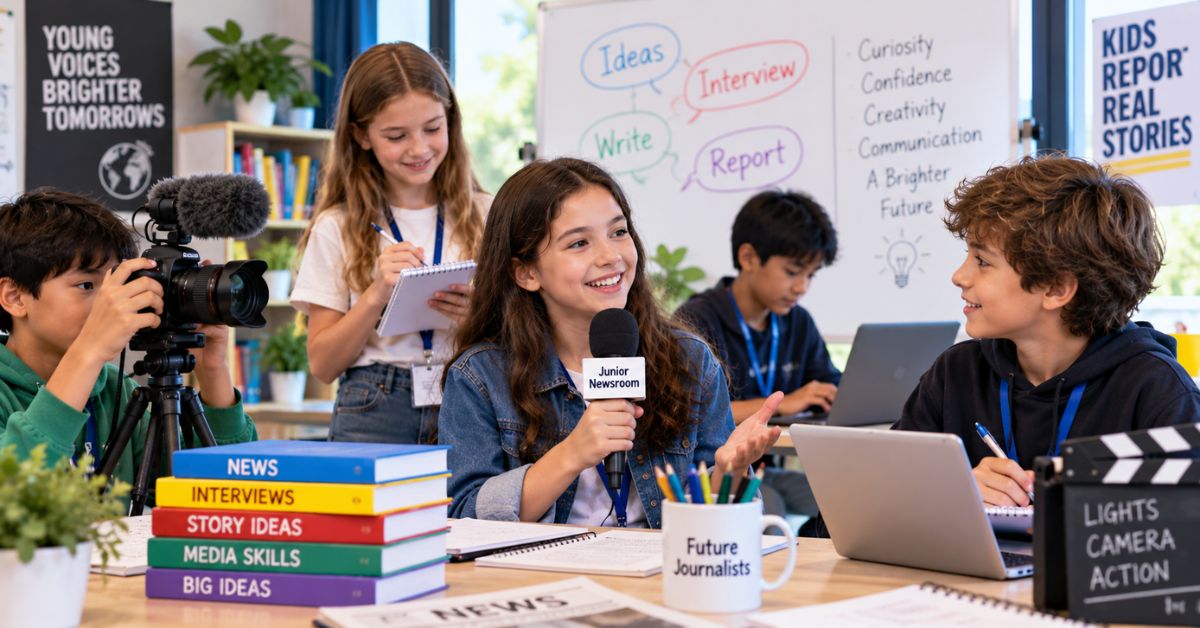
Junior Newsroom gives children a concrete reason to ask better questions and think about the people listening to their stories. At RARE Learning’s Junior Newsroom, campers explore video journalism by developing a news bulletin with a professional instructor. The program brings storytelling, interviewing, and performance together in one project.
For a child who enjoys explaining events, discovering details, or speaking on camera, that combination makes an appealing summer experience. Its strongest advantage is the connection between the work and its purpose: every question, explanation, and presentation contributes to something an audience can watch.
A Reporting Project With a Clear Purpose
A news assignment gives curiosity a direction. Imagine a young reporter covering a neighborhood garden. “There are plants here” tells viewers very little. Explaining who maintains the garden, what grows there, and why neighbors use it creates a story worth following.
That example illustrates why a newsroom format suits aspiring journalists. It invites children to move beyond noticing something interesting and consider what another person needs to understand.
A useful report also requires choices. Which detail belongs first? What needs explaining? What can be left out? Thinking through those decisions gives writing a practical purpose. A young reporter has to make information understandable to someone encountering the subject for the first time.
Several Ways to Discover a Reporting Interest
The Junior Newsroom program includes anchor segments, breaking news, investigative journalism, entertainment updates, and weather reporting. This range offers several ways into the project.
Each format presents a different communication challenge:
- An anchor needs to introduce a subject clearly and help viewers follow the bulletin.
- A breaking news report calls for a concise account of what is known.
- An investigative story begins with a question that deserves closer attention.
- An entertainment update needs a clear reason the subject will interest its audience.
- A weather report makes conditions and forecasts understandable and useful.
For a young journalist, encountering these differences can help clarify what feels engaging. A child drawn to careful explanation may discover a different interest from one who enjoys lively presentation. Both have a place in journalism.
Interviewing That Starts With Listening
Interviewing is especially valuable because it requires attention to another person’s experience. A prepared question starts a conversation; the answer determines where it should go next.
Consider an interview about a school performance. “Was it fun?” usually produces a short response. “What was the hardest part to prepare?” invites a more revealing answer. A thoughtful follow-up might then uncover an unexpected problem or a moment of pride.
This is the practical value of including interviews in a journalism project. Children have a reason to listen closely, ask for clarification, and make room for someone else’s perspective.
The standard for a strong interview is straightforward: help the audience understand something it could not learn from a quick description alone.
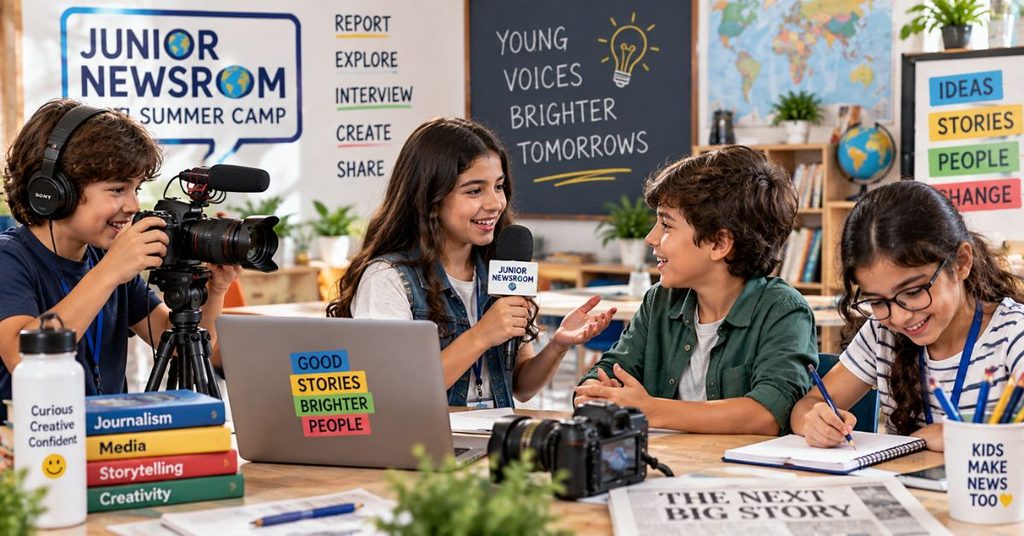
Practice Making Spoken Stories Easy to Follow
Video reporting adds an important challenge to storytelling: viewers need to understand the message as they hear it. A sentence that looks impressive on paper can become confusing when spoken aloud.
For an aspiring reporter, a useful exercise is to read an explanation aloud and notice where the meaning gets lost. Perhaps a sentence contains too many details. Perhaps an unfamiliar word needs explaining. Shortening the sentence or adding context can make the story easier to follow.
Presentation also involves pace, emphasis, and tone. A weather explanation and an entertainment update should sound appropriate to their subjects.
These are concrete reasons to value the camp’s performance focus. Confidence can grow from knowing what to communicate and how to make it clear, with skills that also have a place in classroom presentations.
Professional Guidance Gives the Project Direction
An adult instructor provides a point of reference when a young reporter has an idea but cannot yet see how to develop it. That guidance is particularly useful in a project with several kinds of stories.
A child may have an interesting subject without a clear angle, or an explanation that assumes the audience already knows too much. Those are useful moments for questions and discussion.
For parents, the value of guided journalism is the opportunity to connect creative enthusiasm with purposeful work. When discussing enrollment, ask how instruction is adapted to different ages and comfort levels. The answer can help establish whether the setting matches your child’s needs.
A Complete Bulletin Makes the Work Visible
At the end of Junior Newsroom, the instructor assembles the segments so participants can watch the complete bulletin.
Watching a finished piece creates an opportunity to evaluate it from the audience’s position. Was the main point easy to identify? Did an interview add something useful? Where did a speaker make a complicated idea clear?
Parents can extend that reflection with specific questions about decisions their child made. “Which part would you change next time?” opens a more useful conversation than a general judgment about whether the video was good.
That habit of reviewing work can give a young journalist a practical starting point for the next story.
Choosing the Camp for Your Child
Junior Newsroom is especially appealing for children who ask questions, enjoy explaining their interests, or wonder how news videos come together. An interest in people can be just as relevant as an interest in performing.
A quieter child may be curious about interviewing or developing a story. Before enrolling, discuss participation expectations with the team, including how speaking roles are handled.
It also helps to ask your child what sounds enjoyable about the project. Their answer can reveal whether the interest is in reporting, presentation, or simply trying a new activity. A summer introduction leaves room for that interest to develop without requiring a career decision.
Frequently Asked Questions
What age group is Junior Newsroom for?
RARE Learning advertises its summer camps for ages 9–15. Confirm eligibility for your selected session before registering.
Where is Junior Newsroom offered?
The posted schedule lists sessions in Coppell, Richardson, Plano, and Allen, Texas. Check the Junior Newsroom schedule for location and session details.
How long are the sessions?
The posted sessions run Monday through Friday, with daily blocks of two hours and 45 minutes. Morning or afternoon timing depends on the session.
Does my child need to bring a camera?
The Junior Newsroom description does not specify equipment requirements. Ask the team what participants should bring before purchasing anything.