
Watch a three-year-old for an afternoon and you’ll notice something: they don’t switch topics on command. A child who’s deep into stacking cups doesn’t suddenly want to sit down for “number time.” Their curiosity runs on its own logic, and it doesn’t respect a schedule that jumps from letters to snack to shapes with nothing tying them together.
That’s the quiet problem inside a lot of preschool days. When activities are chopped into unrelated pieces, young children lose the plot. They finish one thing, the teacher resets the room, and everyone begins again from nothing. Attention leaks out at every transition.
Theme-based learning school is the fix a lot of experienced teachers reach for. Instead of teaching skills in separate boxes, you build the whole week (or month) around one big idea a child can sink into: the ocean, a bakery, things that grow in a garden, how a house gets built. Every corner of the room points back to that idea. The counting, the storybooks, the painting, and the pretend play all belong to the same world. That small shift changes how much a child takes in, and it’s worth understanding why.
What a theme-based classroom looks like in practice
Say the theme for the week is a bakery. This isn’t one bakery craft on Monday and back to normal on Tuesday. The dramatic play corner becomes a shop with an apron, a toy register, and empty flour bags. At the art table, kids decorate paper cakes. Story time is a book about a baker. During snack, the class talks about how the muffins in front of them were made. Outside, someone’s “delivering bread” on a tricycle.
None of these are separate lessons. A child moves from the play kitchen to the book corner and the idea travels with them. They’re not starting from scratch each time; they’re adding another layer to something they already care about. That continuity is the whole point, and it’s the thing a themeless day can’t offer.
Why connected activities hold a child’s attention
Short attention spans are normal at this age. What’s easy to miss is how much of that lost attention comes from constant restarting. Every time an activity has nothing to do with the last one, a young child has to reorient: new rules, new materials, new reason to care. That cold start is tiring, and it’s where kids check out.
A theme removes most of those cold starts. Because everything relates back to one familiar idea, a child stays warmed up. They already know what a bakery is by Wednesday, so when a new bakery activity appears, they’re curious instead of confused. Familiarity does something useful here. It frees up a child’s energy to notice details, ask questions, and stick with a task a little longer than they usually would.
I once watched a group of four-year-olds who normally wandered off after a few minutes spend nearly half an hour “running a pizza restaurant.” Nobody made them. The shared story was interesting enough to hold them, and that kind of sustained, self-driven focus is exactly what you want to see before kindergarten.
How themes deepen what children learn
Engagement is only half the value. The other half is that a theme changes the quality of what a child walks away with. Two areas show this clearly.
Turning abstract ideas into something kids can touch
Preschoolers understand the world through their hands, not through explanation. Try telling a three-year-old what “heavy” means and you’ll get a blank look. Hand them a heavy bag of pretend potatoes at the market and they get it instantly.
This is where themes earn their keep. A big idea gives you a natural excuse to make abstract concepts physical. During a construction theme, measuring isn’t a worksheet; it’s figuring out whether a block tower is taller than the one next to it. Sorting isn’t a drill; it’s putting all the long pipes in one bin and the short pipes in another because the site needs them organized. The math and early science are still there. They’re just wearing a costume the child recognizes. When a concept shows up inside a story a child is already living, it stops feeling like school and starts feeling like the natural next thing to do. That’s usually when it sticks.
The vocabulary boost hidden in a good theme
Here’s something parents notice fast: after a themed week, kids come home using words nobody sat them down to teach. A week on the ocean, and suddenly a four-year-old is talking about tentacles and currents and gills.
That’s not an accident. Vocabulary sticks when a child hears a word many times, in different situations, all pointing at something real. A single mention of “veterinarian” on a flashcard fades by lunch. But if the whole week is about animal care, with a pretend vet clinic, a story about a sick puppy, a song, and a chat about a real pet, that word gets used and reused until it belongs to the child. The words also come with meaning attached. A child who has “examined” stuffed animals at the pretend clinic doesn’t just know the word examine. They know what it feels like to do it.
Building social skills through shared play
A theme gives a whole class the same imaginary world to step into, and that turns out to matter a lot for how children play together. When everyone understands they’re “running a restaurant,” they don’t need much prompting to start sorting out who’s the chef, who takes orders, and who’s waiting for a table.
That negotiation is where real social learning happens. Kids practice taking turns, handling the disappointment of not getting the role they wanted, and reading when a friend is upset. A shared script lowers the barrier to cooperative play, so more kids join in and stay in it longer. Compare that to open free play with no anchor, where younger children often drift into playing next to each other rather than with each other. Give them a common theme and the “with” tends to show up on its own.
What theme-based planning gives teachers
For the adults running the room, a theme does more than entertain the kids. It gives planning a backbone, and it solves a few real headaches at once:
- It makes it easier to follow the children’s own interests. If the class gets obsessed with bugs, you can spin up a bug theme and ride that enthusiasm instead of fighting it.
- It weaves several skills into one week without cramming in separate lessons. Counting, fine motor work, storytelling, and early science can all live inside a single theme, so nothing feels bolted on.
- It flexes for a mixed room. The same post office theme can have a two-year-old stamping paper while an older child sorts pretend mail by number. One idea, many levels.
- It makes watching and assessing children feel natural. Instead of formal testing, a teacher learns what a child knows by seeing how they play inside the theme.
- It cuts down on planning from a blank page. Once the big idea is set, the individual activities start to suggest themselves.
Choosing themes that click with young children
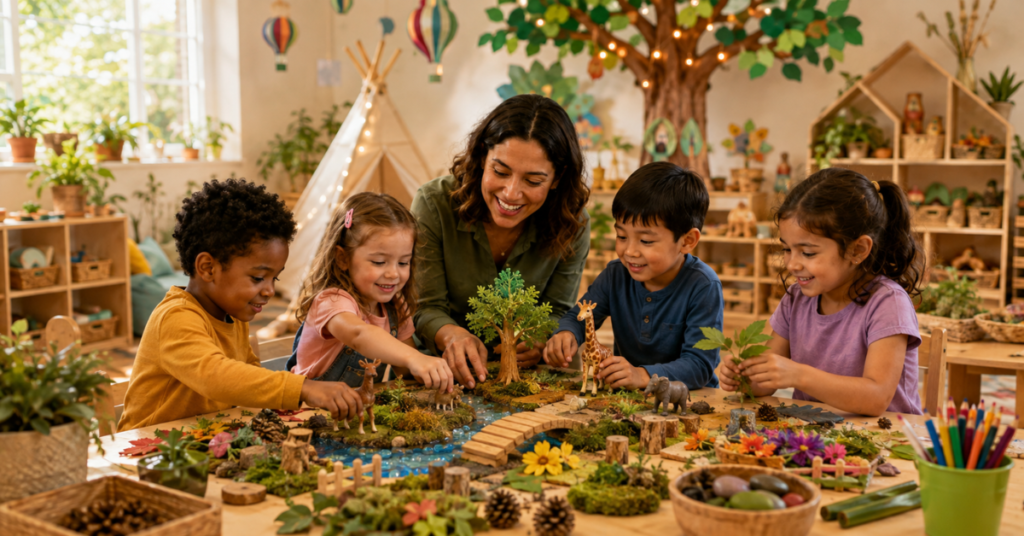
Not every theme lands. The solar system sounds educational but means little to a child who can’t picture space. The grocery store clicks immediately, because every kid has stood in one holding onto a cart. The strongest themes come from a child’s real, everyday world, not from what adults think is impressive.
A few things separate a theme that hums from one that fizzles:
- It connects to something children have experienced firsthand. Pets, food, weather, a trip to the doctor: familiar ground gives them somewhere to start.
- It’s open enough to explore in many directions. A theme like water can travel toward rain, boats, bath time, or the sea, which means one word gives you weeks of material.
- It invites the senses. Themes kids can touch, smell, hear, and move around in beat themes they can only be told about.
- It can stretch or shrink. If interest fades on Tuesday, you wrap up. If they’re still hooked on Friday, you keep going. A good theme bends to the kids, not the other way around.
- It leaves room for their questions. The best themes often get reshaped by what children ask mid-week, so the plan stays loose enough to follow a real “but why?”
How the benefits show up at home
You don’t need to be in the classroom to see whether this is working. The signs come home with your child. After an immersive theme, kids narrate it at dinner, act it out in the bath, and start spotting the theme out in the real world: pointing at a construction crane, naming the baker at the actual bakery, asking where rain comes from.
That last part is the real payoff. Theme-based learning teaches children to connect what they did at school to what they see everywhere else. A child who spent a week on the neighborhood starts paying attention to mail trucks and street signs and traffic lights that were invisible to them before. Curiosity like that doesn’t switch off at pickup, and once a child starts linking ideas across their day, they’ve picked up a habit that outlasts any single theme.
Engagement isn’t a trick
The reason theme-based learning keeps young children engaged isn’t complicated, and it isn’t a gimmick. It works because it matches how a preschooler’s mind already runs: as one curious whole, not a set of subjects taking turns. When counting, reading, painting, and pretending all belong to the same story, learning stops feeling like a string of interruptions and starts feeling like play a child chooses on their own.
The programs that get the most out of it keep their themes loose and led by the children, ready to change when a class gets fascinated by something no one planned. That flexibility is the part worth protecting. Structure helps, but the moment a theme becomes a rigid script the adults enforce, it loses the very thing that made it work. Get the balance right, and you end up with a room full of kids who are fully absorbed, which, at this age, is where all the real learning lives.
Frequently asked questions
What age is theme-based learning best for?
It works well across early childhood, roughly ages two to five, and it scales for each stage. Younger toddlers do best with simple, sensory themes tied to daily life, while older preschoolers can handle themes with more moving parts and open-ended questions.
How long should a preschool theme last?
Usually somewhere between one and three weeks. Long enough for a child to go deep and revisit the idea from different angles, short enough that interest doesn’t fade. The honest answer is to follow the children: stretch it while they’re hooked, and wrap it up when the energy drops.
Does theme-based learning still cover letters, numbers, and school-readiness skills?
Yes. The academics are built into the theme rather than taught on the side. Kids count the apples at the pretend market, spot the letter their name starts with on a “delivery,” and practice writing by taking pretend orders. The skills are the same as in any other program. They just arrive wrapped in something a child cares about.
What are some good preschool theme examples?
Themes rooted in a child’s everyday world tend to work best: the grocery store, a bakery or restaurant, animals and pets, weather and seasons, the ocean, building and construction, gardens, or the local neighborhood. The test is simple: can the child picture it and act it out?
Can I use theme-based learning at home?
Yes, and it doesn’t take a lesson plan. Pick something your child is already into, then let it show up for a few days in the books you read, the games you play and the things you point out on a walk. A week of “bugs” can mean a bug book at bedtime, hunting for ants in the yard, and drawing the ones you find. Follow their interest and keep it light.