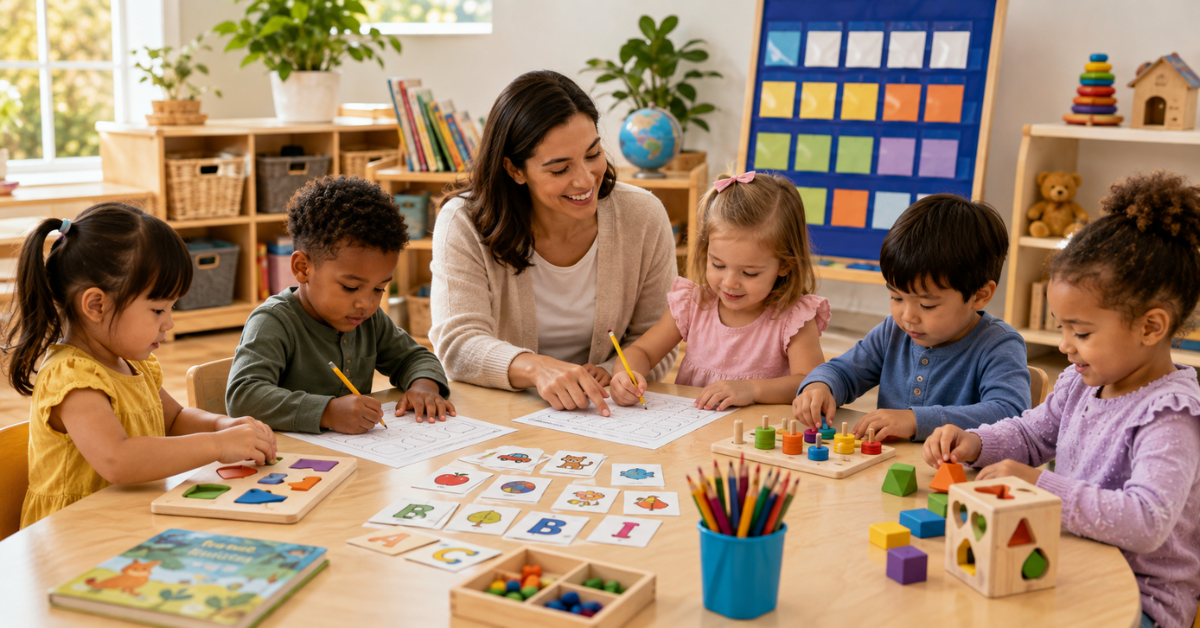
Kindergarten readiness is often reduced to a simple checklist: recognize letters, write a name, count objects, and identify basic shapes. Those abilities matter, but they are only part of what children need to handle a kindergarten classroom successfully.
A child may know the alphabet and still struggle to follow a two-step direction. Another may count well but find it difficult to wait for a turn, explain a problem, or move calmly from one activity to another. When early learning consists of disconnected worksheets, apps, videos, and occasional activities, these less visible gaps can be easy to miss.
A structured academic curriculum solves that problem by giving children a clear, connected path toward kindergarten. It identifies what children are learning, introduces skills in a sensible order, provides time to practice, and adjusts instruction as each child progresses. Just as importantly, structure does not have to mean long lessons, rigid expectations, or a preschool classroom that feels like elementary school.
School readiness includes language, literacy, thinking, social-emotional development, approaches to learning, and physical and motor development. Texas guidelines expand this preparation across ten connected areas, including reading, writing, math, science, social studies, fine arts, physical development, and technology.
The most effective approach is structured enough to prevent learning gaps, flexible enough to respect individual development, and engaging enough to protect a child’s natural curiosity.
What a Structured Academic Curriculum Really Means
The word “structured” can sound restrictive, especially when discussing young children. In a high-quality pre-K setting, however, structure means intentional planning rather than rigid instruction.
Teachers know which concepts they are introducing, why those concepts matter, and what children should be ready to learn next. Activities may look playful on the surface, but each one serves a purpose.
A Clear Sequence Helps Skills Build Naturally
Young children learn more effectively when new ideas connect to something they already understand.
Early literacy, for example, might progress from hearing rhymes to identifying beginning sounds, recognizing letters, connecting letters with sounds, and eventually combining sounds in simple words. A math sequence may begin with sorting and comparing objects before moving to counting, number recognition, patterns, measurement, and simple addition concepts.
Without this progression, children may memorize isolated facts without understanding how they fit together. A child who can recite numbers to 20 may still be unable to give someone five blocks. A child who sings the alphabet song may not recognize the letters in their own name.
A planned sequence allows teachers to strengthen the underlying concept before moving forward.
Predictable Routines Create More Space for Learning
Structure also appears in the daily rhythm of the classroom. Children benefit from knowing that group conversation may be followed by a hands-on activity, a learning center, movement, a story, and a chance to practice independently.
Predictability reduces the mental effort required to figure out what is happening next. Children can focus more of their attention on the learning task itself.
Intentional instruction works best when it is brief, interactive, and followed by hands-on practice. Small-group experiences make it easier for teachers to offer additional support or introduce greater challenges without expecting every child to complete the same task at the same pace.
Kindergarten Readiness Has Five Interconnected Foundations
Academic knowledge cannot be separated from the skills children use to participate in learning. A complete kindergarten-readiness curriculum develops five foundations together:
- Language and early literacy: Listening, speaking clearly, building vocabulary, enjoying books, hearing sounds in words, recognizing letters, and beginning to communicate through writing.
- Mathematical thinking: Counting with meaning, comparing quantities, recognizing patterns, describing shapes, measuring informally, and solving simple problems.
- Attention and self-regulation: Remembering directions, controlling impulses, shifting between tasks, persisting when something feels difficult, and managing emotions.
- Social communication: Taking turns, joining group activities, resolving small conflicts, asking for help, and expressing needs appropriately.
- Physical and practical independence: Using pencils, scissors, and classroom materials while also managing personal belongings, cleanup routines, handwashing, and other everyday responsibilities.
These foundations reinforce one another. A child uses language to explain a math solution, self-control to participate in a game, fine-motor skills to form letters, and social skills to complete a group science project. That is why readiness should never be measured by reading and counting alone.
Building Early Literacy as a Communication System
Early literacy is sometimes treated as a race to make children read independently. A stronger approach develops the complete communication system behind reading and writing.
Oral Language Comes Before Independent Reading
Children need opportunities to hear interesting words, explain their thinking, describe experiences, ask questions, and participate in real conversations.
Consider a classroom discussion about animals. Instead of asking only, “What animal is this?” a teacher might ask:
“What do you notice about its feet?”
“Where do you think it lives?”
“How is it different from the animal in the other picture?”
These questions encourage children to observe, compare, recall information, and speak in complete ideas. The conversation develops vocabulary and comprehension while also strengthening reasoning.
Shared book reading is especially valuable when children are active participants. Teachers can pause to discuss an unfamiliar word, predict what may happen, examine how print works, connect the story to a child’s life, or revisit an important idea after reading. These conversations help children build language, print knowledge, sound awareness, and knowledge about the wider world.
Sound Awareness Should Connect to Meaningful Print
Letter instruction becomes more memorable when it relates to something children recognize.
A teacher introducing the letter S might begin with a child’s name, search the classroom for objects beginning with the same sound, say a playful alliteration, and then invite children to form the letter with clay or trace it in sand. The child hears the sound, sees the symbol, says it aloud, and creates it physically.
This is more powerful than repeatedly copying an unfamiliar letter on a worksheet because the child is working with sound, meaning, movement, and print at the same time.
Early Writing Begins With Ideas
Children do not need conventional spelling before they begin to see themselves as writers. Drawing a picture and adding a label, attempting a name, making a grocery list during pretend play, or dictating a sentence to a teacher all help children understand that marks and letters can communicate meaning.
The immediate goal is not perfect handwriting. It is helping the child connect spoken language, ideas, and print while gradually building pencil control and letter formation.
Teaching Math Through Objects, Language, and Everyday Problems
Early mathematics should go beyond memorizing number names. Children need to understand what numbers represent and how mathematical ideas help them describe and solve problems.
Concrete Materials Make Abstract Ideas Visible
Blocks, counters, puzzle pieces, cups, buttons, toy animals, and board games allow children to see and manipulate quantity.
Suppose two children are preparing a pretend picnic for four stuffed animals. They must determine whether there are enough plates, how many cups are missing, and whether each animal has the same amount of food. The activity introduces one-to-one correspondence, comparison, addition, subtraction, and equality without requiring a formal worksheet.
The teacher can make the learning more precise by introducing words such as more, fewer, equal, longer, shorter, between, and under. Children are better able to understand mathematical instruction when they have frequent opportunities to hear and use the language of math.
Math Should Appear Throughout the Day
A structured curriculum assigns dedicated time to math, but it also helps children notice mathematical ideas during ordinary routines.
Children can count how many classmates are present, compare the heights of block towers, divide art supplies among a group, identify shapes on a walk, create patterns with beads, or estimate which container will hold more water.
These experiences show children that math is not simply a school subject. It is a useful way to organize information and make decisions.
Using Science to Strengthen Curiosity and Academic Language
Science gives young children meaningful content to discuss, classify, measure, draw, read about, and investigate.
A lesson about plants can connect several areas of the curriculum. Children may examine seeds, compare their sizes, count how many are planted, predict which will sprout first, observe changes, draw what they see, and learn words such as root, stem, soil, and moisture.
The value is not in having children memorize complex definitions. It is in teaching them to notice details, ask purposeful questions, make predictions, test ideas, and explain what happened.
RARE Learning’s curriculum includes hands-on experiences across science, math, reading, writing, and problem-solving activities. This combination helps children connect academic language with objects and situations they can see and explore.
The Hidden Curriculum: Attention, Self-Regulation, and Independence
Many of the skills that determine whether a child can participate successfully in kindergarten do not appear on a traditional academic worksheet.
A kindergarten student may need to remember several directions, wait while someone else speaks, stop one activity and begin another, keep track of materials, and continue working after making a mistake. These demands rely on attention, working memory, flexible thinking, and impulse control.
These Skills Can Be Practiced Through Games
Games create natural opportunities to listen, remember rules, take turns, and adjust behavior.
“Simon Says” requires children to listen for a specific cue before acting. A matching game asks them to remember where pictures are located. A block-building challenge may require them to follow a sequence such as, “Build a tower with three large blocks, then place two smaller blocks on top.”
The academic content may involve colors, numbers, shapes, or vocabulary, but the child is also learning to pause, plan, remember, and persist.
Independence Should Be Taught, Not Assumed
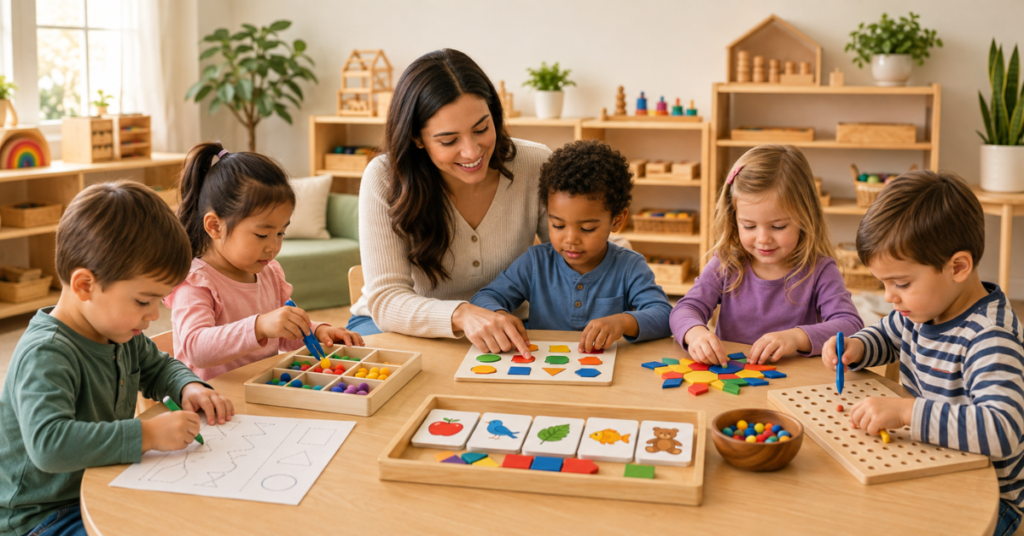
Children also need guided practice with everyday classroom responsibilities. Teachers can show them how to select materials, finish a task, return items to the correct place, ask for assistance, carry their belongings, and participate in cleanup.
These routines may appear simple to adults, but they reduce frustration during the transition to kindergarten. A child who knows how to manage materials and seek help appropriately has more attention available for learning.
Personalization Keeps Structure From Becoming Pressure
A structured curriculum should provide a common direction, not force every child into the same pace.
One child may recognize letters but need help expressing ideas in complete sentences. Another may have a strong vocabulary but still be developing sound awareness. A third may understand number concepts well but need support staying with a task.
Small-group and one-on-one instruction allow teachers to work on the same broad learning goal at different levels. During a pattern activity, one child may copy a two-part color pattern, another may extend a more complex sequence, and another may create a pattern and explain its rule.
RARE Learning’s Pre-K model combines planned instruction with individual attention, personalized learning activities, low teacher-student ratios, and short learning segments. This makes it possible to preserve a clear curriculum while responding to the child in front of the teacher.
Personalization should not mean randomly changing activities based on what seems entertaining that day. It means identifying the next useful step within an organized learning progression.
Play, Games, and Technology Should Serve a Learning Goal
Structured learning and play are not competing approaches. Purposeful play is one of the most practical ways to deliver an early academic curriculum.
A pretend restaurant can involve writing orders, recognizing environmental print, counting money, comparing quantities, cooperating with classmates, and solving customer problems. A board game can strengthen number recognition, strategy, turn-taking, and emotional control. A construction challenge can develop measurement, spatial reasoning, planning, and vocabulary.
Play-based learning is most effective when teachers know what concept the activity supports and participate through prompts, demonstrations, and thoughtful questions. Developmentally appropriate instruction should be joyful, engaging, responsive to individual strengths, and connected to a child’s language, culture, abilities, and experiences.
Technology can also support a learning goal when an adult helps the child connect the screen activity to conversation and hands-on practice. For example, after completing a digital pattern activity, a child might recreate the pattern with blocks and explain the rule to a teacher.
Technology should remain one tool among many. It should extend opportunities to create, communicate, explore, or practice rather than replace books, physical materials, outdoor activity, conversation, and imaginative play.
RARE Learning’s curriculum philosophy reflects this balance by combining computers and educational media with board games, hands-on activities, discussion, and one-on-one guidance.
Progress Monitoring Turns Activities Into Responsive Instruction
A classroom can be busy without being instructionally effective. Children may complete many projects while teachers remain unsure about which concepts have been mastered.
Progress monitoring gives purpose to the curriculum. Teachers observe what a child can do independently, what the child can do with a prompt, and what still causes confusion. They can then decide whether to provide more practice, present the concept differently, or move to the next step.
This does not require constant formal testing. Useful information can come from conversations, games, drawings, writing attempts, small-group work, and daily routines.
Children also develop at different rates. Early-learning guidelines should guide planning rather than function as a rigid checklist or a label for what a child can and cannot become.
RARE Learning provides periodic progress reports organized by learning areas and evaluates children in relation to their own previous accomplishments. This type of communication helps families understand both current growth and the next instructional priority.
For an early learning provider, a defined curriculum and a consistent progress-monitoring process also improve program quality. Educators can coordinate instruction, identify areas that have received too little attention, and communicate with families using specific examples rather than vague descriptions.
Family Partnership Helps Children Use Skills Beyond School
Children gain a deeper understanding when a classroom concept reappears in everyday life.
A parent does not need to recreate the preschool classroom at home. Simple conversations and routines can extend learning naturally. A child can compare prices at a grocery store, count plates while setting the table, look for a familiar letter on a sign, retell part of a bedtime story, sort laundry, or describe how the weather changed during the day.
The adult’s role is to make the connection visible:
“You gave everyone one spoon. How did you know we had enough?”
“That sign begins with the same sound as your name.”
“What do you think will happen if we put this ice in the sun?”
These short exchanges encourage children to apply knowledge rather than merely repeat it.
Families are central to school readiness because they provide information about the child’s interests, language, routines, strengths, and needs. Regular communication between families and educators makes it easier to reinforce the same skills in meaningful ways.
What Parents Should Look for in a Kindergarten-Readiness Program
When comparing preschool or academic enrichment programs, parents should look beyond attractive classrooms and long lists of activities. A strong program should offer:
- A clear learning progression across literacy, math, science, communication, social development, motor skills, and approaches to learning.
- Brief, purposeful instruction followed by conversation, movement, games, exploration, and hands-on practice.
- Individual or small-group support that adjusts the difficulty without abandoning the overall curriculum.
- Language-rich teaching in which children explain ideas, ask questions, hear new vocabulary, and participate actively in stories.
- Meaningful progress communication that shows what the child has learned, what is developing, and what comes next.
- A healthy balance of tools, including books, art materials, manipulatives, physical play, board games, imaginative activities, and carefully selected technology.
Parents should also pay attention to how the child responds. A well-designed program should challenge children without making them afraid to be wrong. Progress matters, but so do confidence, curiosity, and the willingness to try again.
Conclusion
Preparing children for kindergarten does not mean pushing elementary-school work into the preschool years. It means deliberately building the knowledge, habits, communication skills, and independence that allow children to benefit from kindergarten when they arrive.
A strong academic curriculum provides direction. Play makes learning active. Individualized instruction keeps the challenge appropriate. Progress monitoring prevents gaps from being overlooked. Family involvement helps children use new skills in the real world.
The best preparation is therefore neither completely unstructured nor unnecessarily rigid. It is planned but responsive, academically meaningful but developmentally appropriate, and challenging without becoming discouraging.
As classroom tools and educational expectations continue to change, children will still need the same lasting foundation: the ability to listen, communicate, reason, cooperate, persist, and approach unfamiliar ideas with confidence. A structured curriculum builds that foundation one connected experience at a time.
Frequently Asked Questions
What is a structured academic curriculum for preschoolers?
It is a planned sequence of age-appropriate lessons and activities that develops literacy, math, science, communication, self-regulation, social skills, and physical independence over time.
Does a structured curriculum mean children spend the day completing worksheets?
No. Structure refers to clear learning goals and progression. Instruction should include books, conversation, games, movement, manipulatives, creative activities, guided play, and short periods of focused practice.
What skills should a child have before entering kindergarten?
Children benefit from early literacy and math knowledge, but they also need to follow directions, communicate needs, participate in groups, manage materials, take turns, attempt tasks independently, and recover from frustration.
How can parents support kindergarten readiness at home?
Parents can read together, discuss new words, count and compare household objects, involve children in simple routines, encourage drawing and writing, play turn-taking games, and ask children to explain their thinking.
How do teachers know whether a child is making progress?
Teachers observe children during conversations, games, stories, learning centers, writing, problem-solving tasks, and daily routines. They use these observations to identify mastered skills, developing abilities, and appropriate next steps.