Say the words “academic preschool” to a room of parents and you’ll get two very different reactions. Some picture bright classrooms full of curious three-year-olds who are learning to think. Others picture rows of tiny desks, worksheets, and a four-year-old being drilled on sight words while the joy quietly drains out of the room.
Both of those places exist. That’s the problem.
The word “academic” tells you almost nothing about quality on its own, because excellent programs and mediocre ones both use it. What actually separates them is what the adults understand about how young children learn, and whether the daily rhythm of the classroom reflects that understanding.
If you’re touring programs and trying to tell the difference, here’s what matters, and what to watch for once you’re standing in the room.
What “academic” should really mean at this age
The strongest academic foundation for a three- to five-year-old isn’t early formal instruction. It’s the set of capacities that everything else is built on later: rich spoken language and a big vocabulary, real knowledge about the world, the fine motor control that eventually makes holding a pencil possible, and the self-control to stick with something hard without falling apart.
Reading and math grow out of those roots. A program that drills decoding and arithmetic into a four-year-old while ignoring the roots isn’t being rigorous. It’s mistaking the visible symptoms of learning for learning itself.
Here’s a simple way to think about it. A child who can name the letter “B” but has never had a real back-and-forth conversation is not ahead. A child with a big vocabulary and the patience to finish a puzzle is, even if she can’t yet read a single word.
The teacher matters more than the method
No philosophy label predicts quality as well as the quality of the adults in the room. Montessori, Reggio, play-based, academic: each one has wonderful versions and weak ones. What you’re really evaluating is how the teachers talk to and treat the children.
Watch the talk. Skilled preschool teachers have long, winding conversations with kids. They ask questions they don’t already know the answer to. They narrate, expand on what a child says, and wonder out loud. Weaker classrooms run mostly on directions and corrections: sit down, not like that, we don’t do that, good job. Directions aren’t bad, but a room built entirely out of them is a room where not much thinking is going on.
It’s also worth asking about staff turnover, because it’s one of the more honest signals of a program’s health. Children this age learn through relationships, and a rotating cast of adults quietly undercuts that.
What a good classroom sounds and looks like in the first ten minutes
You can learn a surprising amount before anyone gives you the official tour.
Listen before you look
A good preschool has a particular sound to it: a productive hum. Voices, movement, blocks clattering, the odd burst of laughter. Total silence is not a sign of a well-run program at this age. It usually means the children are being tightly controlled, or parked in front of a screen. Chaos isn’t the goal either. You’re listening for busy, not loud, and definitely not silent.
Read the walls
Are they covered in twenty identical crafts, every paper snowman cut from the same template? That tells you the art is really the adult’s and the children just traced the lines. Genuine preschool work is gloriously uneven. Twenty children painting the same subject should give you twenty different paintings.
Watch where the teachers put their bodies
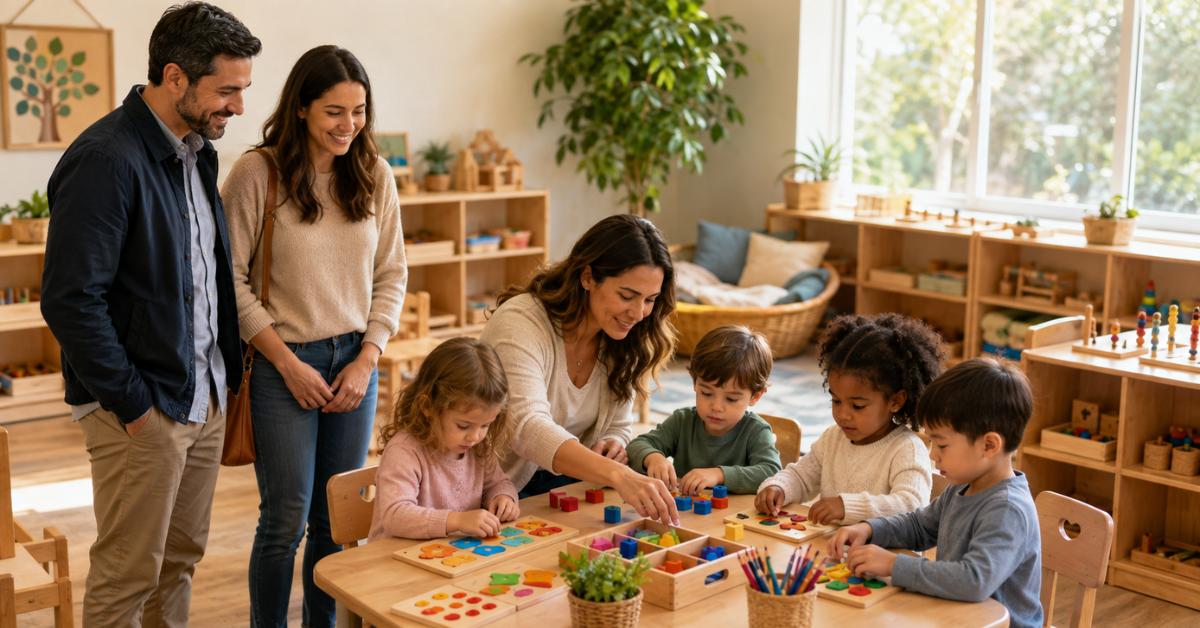
Are they down on the floor, at eye level with a child? Or standing over the room, managing it from above? The best early educators spend a lot of their day low to the ground.
Check whether children can do things themselves
Look for materials on low, reachable shelves, coat hooks kids can actually use, a child getting her own snack, two children sorting out a small squabble before an adult swoops in. Independence at this age isn’t neglect. It’s the whole point.
Play with a purpose, not just supervision
Free play is essential. But there’s a real difference between a teacher who thoughtfully sets up the room to nudge learning along and one who is simply keeping children safe until pickup.
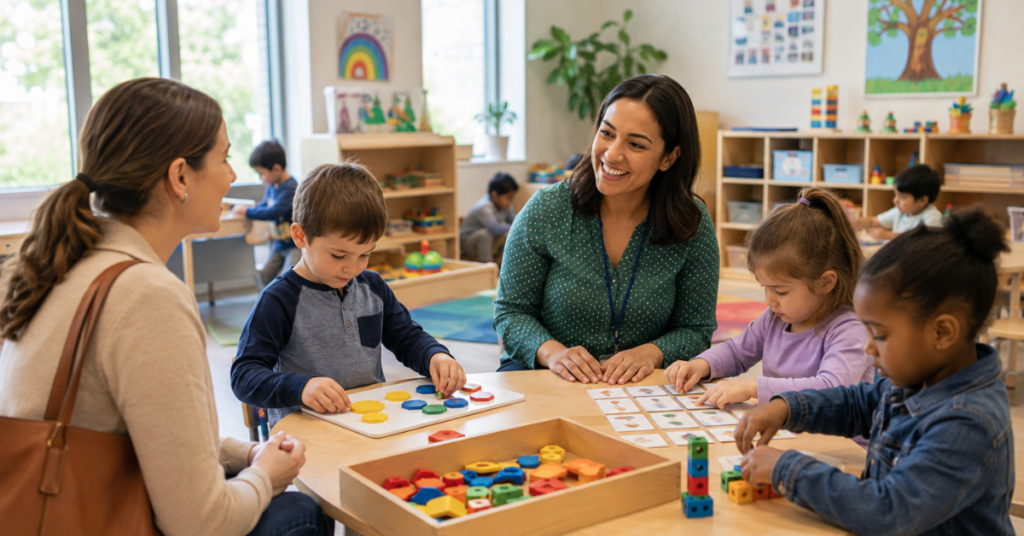
Good teachers make deliberate choices about what to put out and why. Measuring cups at the water table this week, because the class has gotten interested in “more” and “less.” A basket of nonfiction books about insects, because two kids found a beetle on the playground yesterday.
A useful thing to ask on a tour is, “How do you decide what activities to put out?” A specific, thoughtful answer tells you there’s intention behind the play. A vague one (“oh, we just rotate the toys”) tells you something too.
Signs the program is building the right foundations
Pay attention to how the program handles self-control. Waiting for a turn, coping with frustration, following a two-step direction, cleaning up a mess. These quieter skills tend to shape how a child manages kindergarten and everything after it, far more than any early academic party trick. Good programs build them on purpose, rather than simply demanding that children comply.
Then there’s the question of how you’ll know your own child is making progress without grades or test scores. The answer is in how the teachers talk about her specifically. “She had a great day!” is pleasant but empty. “She’s been really into building tall towers and gets frustrated when they topple, so we’ve been working on trying again” tells you a teacher genuinely sees your kid.
Red flags worth taking seriously
Some things should give you pause, even in a program that looks polished on the surface:
- Worksheets and workbooks for three- and four-year-olds. Pencil-and-paper drilling at this age mostly teaches compliance, and it crowds out the hands-on experiences that actually build the skills the worksheets are pretending to measure.
- Long stretches of whole-group sitting. A twenty-minute circle time for a room full of four-year-olds is a losing battle. Most simply can’t attend that long, and forcing it sets a sour tone for the whole day.
- Screens used as a regular teaching tool. An occasional video isn’t a disaster, but a program that leans on tablets or the TV is outsourcing the one thing that matters most here, which is human interaction.
- Big promises about outcomes. Anyone guaranteeing your child will read by four is selling something. Reading readiness varies enormously between perfectly normal, healthy kids.
- No outdoor or active time. Young children need to move. A program that keeps them seated and indoors all day is ignoring how their bodies and brains are built.
- Teachers who can’t answer “what do you do when a child melts down?” Their answer reveals their entire approach to behavior. A vague or punitive one is a warning worth heeding.
Questions to ask on a tour
A short list of questions will tell you more than any glossy brochure:
- What does a typical day look like, from drop-off to pickup? You’re listening for a balance of active and quiet, group and solo, indoors and outdoors.
- How long have the teachers been here? Stability is a decent proxy for a healthy workplace and consistent care for your child.
- How do you handle conflicts between children? You want to hear coaching and problem-solving, not just separation and punishment.
- How will I know how my child is doing? Look for real, specific communication rather than a daily “good day” sticker.
- What happens when a child isn’t interested in an activity? A good program follows children’s interests instead of forcing everyone through the same hoop.
The best program is the one that fits your child
The objectively “best” school in town isn’t automatically the best one for your kid. Temperament matters more than parents expect. A quiet, sensitive child can disappear inside a big, high-energy room. An intense, physical child can bounce off the walls in a very loose, unstructured one.
So on your visit, don’t just size up the program in the abstract. Picture your specific child in that specific room. Watch the children who remind you of yours, and notice whether they seem settled and engaged or a little lost.
Trust your eyes over the brochure
The phrase academic preschool sets up a false choice between rigor and joy, as if a program has to pick one. The best ones flatly refuse to. Real academic strength at this age is built through rich conversation, purposeful play, warm relationships, and the slow work of learning to focus and try again after something goes wrong. None of that looks like a miniature elementary school, and almost none of it fits on a marketing page.
So trust what you see and hear over what you’re told. Spend your visit watching how the adults speak to the children, whether the room hums with the right kind of busy, and whether you can picture your own child thriving there. A preschool that gets the foundations right won’t only prepare your child for kindergarten. It will teach her that learning is something worth loving, which is the one lesson that keeps paying off long after she’s forgotten her first classroom.
Frequently asked questions
Is an academic preschool better than a play-based one?
The label matters far less than the quality behind it. The strongest programs blend both: purposeful, hands-on play guided by skilled teachers. In practice, a great “academic” program and a great “play-based” program often look remarkably similar once you’re in the room.
Should my child know how to read before kindergarten?
No. Most children aren’t ready to read at four, and pushing it rarely helps. What matters much more is a strong vocabulary, an ear for the sounds inside words, and a love of being read to. Those are the foundations reading is actually built on.
What’s a good child-to-teacher ratio for preschool?
For three- to five-year-olds, roughly one adult for every eight to ten children is a reasonable benchmark, and smaller is generally better. More important than the exact number is whether the teachers can give individual attention or are stuck doing crowd control.
How much screen time is normal in a good preschool?
Very little, ideally close to none during the school day. Occasional use isn’t alarming, but screens shouldn’t be a regular stand-in for hands-on activities or real conversation with adults.
How can I tell my child is learning if there are no grades or worksheets?
Listen to how the teachers describe her. Specific observations about what she’s working on, curious about, or struggling with are far better evidence of real learning than any worksheet or report card could be at this age.