Ask a room of parents what preschool is for, and you’ll usually hear two answers that don’t agree with each other. Some see it as a safe, friendly place to leave a young child for a few hours. Others treat it like an early race, where the goal is to have a four-year-old reading before the neighbor’s kid does. Both views miss the more interesting thing that’s going on in those years.
Before a child ever sits in a kindergarten classroom, something quieter is being built: the way they approach learning itself. Whether they can pay attention when it’s hard. Whether they bounce back after getting something wrong. Whether they walk into a new situation curious or nervous. These habits form early, and here’s the part that surprises people. A small head start at age four rarely stays small. It grows.
The head start that keeps growing
Learning stacks. Almost nothing a child learns in school stands alone; each new skill leans on the ones underneath it. A kid who shows up to kindergarten comfortable with language follows the teacher’s directions the first time, so they spend the year learning instead of trying to keep up. That means they walk into first grade a little further along. Then the same thing happens again.
Picture two children with roughly the same natural ability. One grew up in a home full of conversation, questions, and picture books. The other didn’t get as much of that, through no fault of their own. At four, the gap between them looks tiny. By third grade, it can look like the difference between a “smart” kid and a “struggling” one. Most of the time it isn’t about intelligence at all. It’s an accumulated distance. One child got a running start and kept adding to it, while the other has been trying to catch up and keep up at the same time, which is exhausting and doesn’t fix itself on its own.
That’s the real reason the early years matter so much. You’re not just teaching a child a few things. You’re setting the slope they’ll climb for the next decade.
What a strong foundation is really made of
If it isn’t flashcards and worksheets, what is it? A genuinely ready child is usually strong in a handful of quiet areas:
- Language deep enough to follow a story and tell one back
- The ability to steer their own attention, even for a few minutes
- Comfort with not knowing something yet, instead of shutting down
- Enough social ease to learn in a room full of other kids
None of these come from a drill. They come from talking, playing, and being around other people. Two of them deserve a closer look, because they’re the ones parents tend to overlook.
The quiet skill that unlocks everything else
People often think a “well-behaved” preschooler is one who sits still. Sitting still isn’t the point. The real skill is being able to direct your own attention and ride out a wave of frustration without falling apart.
Here’s why it matters more than it sounds. When a five-year-old hits something hard and gets flooded with frustration, that feeling takes up all the space in their head. They physically can’t hear the next instruction, because they’re busy managing the storm. So they miss the lesson, not because they couldn’t understand it, but because they never made it that far. A child who has practiced calming themselves gets to stay in the room, mentally, and keep learning. Preschool is one of the few low-stakes places to build that muscle, where a meltdown over a shared crayon has no lasting cost.
How kids decide whether they’re “good at” learning
Somewhere in these years, children start telling themselves a story about who they are. One version goes, “I’m the kind of kid who figures things out.” Another goes, “I’m the kid who gets things wrong.” That story is sticky, and it forms far earlier than most parents realize.
A preschooler who gets a little room to struggle, and gets noticed for trying rather than only for being right, tends to build the first story. A child who’s constantly rushed, corrected, or made to feel behind can quietly decide that school is the place where they fail. Once that belief settles in, it shapes how hard they try for years, well before anyone has taught them to read a full sentence.
Learning is a group activity
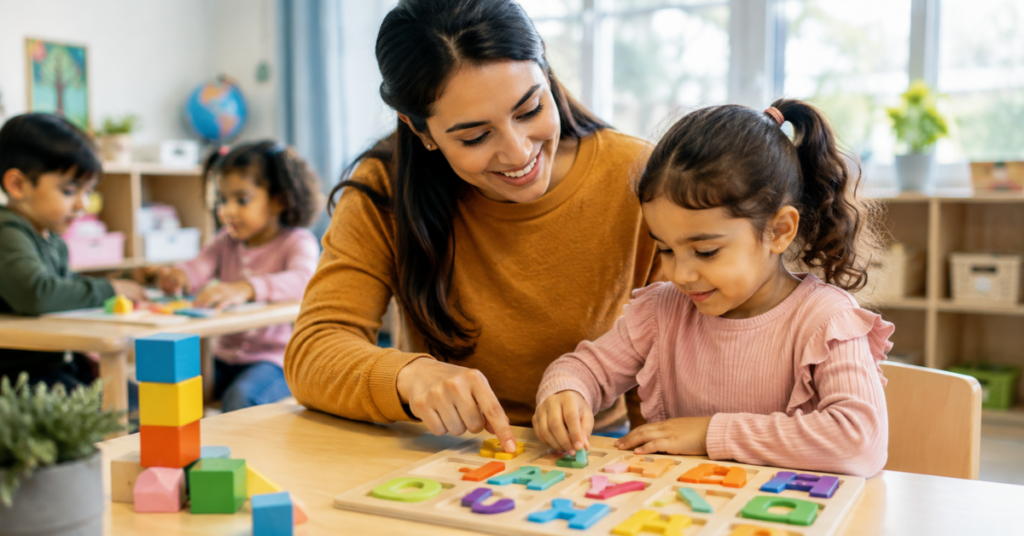
A classroom is, above everything else, a room full of other people. How much a child gets out of it depends heavily on how well they can operate inside that crowd. Taking turns, reading when another kid is upset, asking for help without shame, patching things up after a squabble over the last spot in line. These aren’t soft extras that are nice to have. They decide how much learning a child can actually reach.
Watch a few four-year-olds in a block corner and you’ll see it. They’re negotiating, compromising, getting frustrated, and working it out. That’s real practice for every group project, every classroom discussion, and every “work with a partner” moment coming down the road. The child who can join in and recover from small conflicts stays engaged and keeps learning. The one who melts down or drifts to the edge of the room misses chunks of the day. Again, the issue usually isn’t ability. Their energy is going somewhere else.
Why these particular years carry so much weight
You can teach an older child plenty. So why the fuss about ages three to five specifically? Young children are unusually open. Habits form fast at this age and tend to stick, for better or worse. It is far easier to build a good relationship with learning early than to repair a soured one later.
Think of it like a young tree. When it’s a sapling, a gentle nudge sets which way it grows. Once it’s grown, you can still shape it, but it takes a lot more effort and it never quite bends the way it would have. None of this means a rough start is permanent. Kids are resilient, and plenty catch up later with the right support. It just means the same effort goes a lot further now than it will in a few years.
What parents can do at home
The good news is that most of what builds this foundation is ordinary, and free. A few things matter more than the rest:
- Talk with your child through everyday moments, not at them. Narrate, ask questions, wait for the answer.
- Let them wrestle with something for a minute before you jump in and solve it.
- Read together for the closeness and the words, not to hit an early reading milestone.
- Offer real choices, small ones, so they get practice making decisions.
- Protect unstructured play instead of packing every hour with an activity.
One warning that runs against instinct. Drilling letters and numbers into a young child can backfire. If the lesson a four-year-old absorbs is that learning means pressure, testing, and getting it wrong in front of someone, you can win the short game and lose the long one. A child who wants to learn will, over time, outpace the one who was front-loaded with facts and quietly taught to dread the whole thing.
What to look for in a preschool
If you’re choosing a program, the signals worth watching for are simple. Look for warm relationships between the adults and the kids, since a child learns best from someone they trust. Look for play at the center of the day, not squeezed into the leftover minutes. Look for teachers who talk with children and follow what they’re curious about, and for room to make choices and small mistakes without a fuss.
Be a little wary of programs that lean hard on worksheets, rankings, and rigid drills for very young children. They can look impressive to an anxious parent and still be building the wrong things.
The bottom line
A strong preschool foundation isn’t a stack of facts a child memorized ahead of schedule. It’s the way they’ve learned to meet something they don’t yet understand. Because that habit compounds year after year, getting it roughly right early pays off for a very long time.
And the payoff is only getting larger. As schools and workplaces put less value on memorizing and more on adapting and teaching yourself, the children who learned how to learn early will have the most room to run. The best thing preschool can hand a child isn’t a head start on the alphabet. It’s a head start on wanting to figure things out.
FAQs
Does my child need to know letters and numbers before kindergarten?
No. Readiness has far more to do with language, attention, and curiosity than with memorized content. Build those, and the letters and numbers come easily once school starts.
Can I build this foundation at home instead of sending my child to preschool?
Much of it, yes, as long as home is full of conversation, play, and reading. The one piece that’s hard to recreate on your own is regular practice getting along with a group of other children.
My child is shy or clashes with other kids. Is preschool a bad fit?
No, it’s usually where those exact skills develop. Look for a warm program that gives gentle support rather than one that pushes kids to toughen up.
Isn’t play just play? How does it help academically?
Play is where attention, patience, problem-solving, and language all get their reps. It’s the training ground for school, not a break from learning.
When should my child start preschool?
It depends on the child more than on a set age. Signs of readiness, like handling short separations, showing some independence, and taking an interest in other kids, tell you more than the number of candles on the cake.