Long before a child reads a book independently, literacy is already taking shape. It begins when a toddler points to a familiar sign, finishes a line from a favourite story, notices that two words sound alike, asks what a label says or tells an elaborate story about something that happened at preschool.
For parents, however the period before kindergarten can create unnecessary pressure. It is easy to assume that school readiness means teaching children to read earlier, complete worksheets or memorise long lists of words. A stronger approach is to develop the underlying skills that make reading and writing easier to understand later.
Singapore’s preschool approach similarly treats language and literacy as part of a broader, developmentally appropriate learning experience. MOE Kindergarten’s literacy programme, for example, incorporates Big Books, songs, rhymes and games rather than relying only on formal exercises.
Building early literacy before kindergarten is therefore less about getting ahead of the syllabus and more about giving children the language, curiosity and confidence to become capable readers.
Early Literacy Is Much More Than Reading Words
A child does not suddenly become literate after learning the alphabet. Several abilities develop together before conventional reading begins.
Strong spoken language creates the foundation
Children need opportunities to hear words, understand their meanings and use language themselves. Everyday conversations help enormously.
Instead of asking, “Did you have fun today?” and receiving a one-word answer a parent might ask, “What was the funniest thing that happened at the playground?” A conversation like this encourages the child to remember events, organise ideas and explain them in sequence.
Vocabulary also grows naturally when adults use specific language. At the supermarket, Look at the fruit” can become These mangoes are ripe, but those green ones are still firm. Children begin encountering words that rarely appear in short everyday instructions.
Children also need to notice how language works
Before reading fluently, children benefit from recognising rhymes, hearing individual sounds, noticing letters and understanding that printed words carry meaning.
A child who points to the word “EXIT” at an MRT station may not technically be reading it yet. Still, the child is beginning to connect print with meaning. Those small discoveries gradually make written language less mysterious.
Why the Years Before Kindergarten Matter
Early literacy preparation changes what happens when formal learning becomes more structured.
A child who has spent years enjoying stories, discussing ideas and playing with sounds does not enter kindergarten seeing books as unfamiliar academic objects. Books already represent humour, information, imagination and time spent with people they trust.
This matters especially because Singapore’s preschool curriculum places importance on building children’s language and literacy foundations while developing confidence and positive attitudes towards learning.
The goal should not be to make kindergarten unnecessary. It should be to make kindergarten approachable.
There is also an important emotional difference. A child who believes, “I can figure this out,” is more willing to attempt an unfamiliar word than one who has already learned to associate literacy with correction and pressure.
ECDA’s guidance for families similarly cautions against turning preparation for formal schooling into excessive academic teaching at the expense of play and age-appropriate learning.
Turn Everyday Routines Into Literacy Opportunities
Families do not need a miniature classroom at home. Some of the richest literacy experiences happen during activities that are already part of the day.
Useful opportunities include:
- Mealtimes: Ask children to describe textures, tastes and ingredients or explain how a simple dish was prepared.
- Travelling around Dallas Fortworth: Notice signs, station names, advertisements and familiar logos. Ask children which letters or words they recognise.
- Shopping: Let children help find products from a short picture-and-word shopping list.
- Bedtime: Read a familiar book, invent a new ending or ask the child to retell part of the story.
- Play: Add menus to a pretend café, tickets to a toy bus, labels to building blocks or a “patient list” to a pretend clinic.
These activities work because literacy has a purpose. The child is using language to accomplish something rather than completing an isolated exercise.
Read With Children, Not Simply to Them
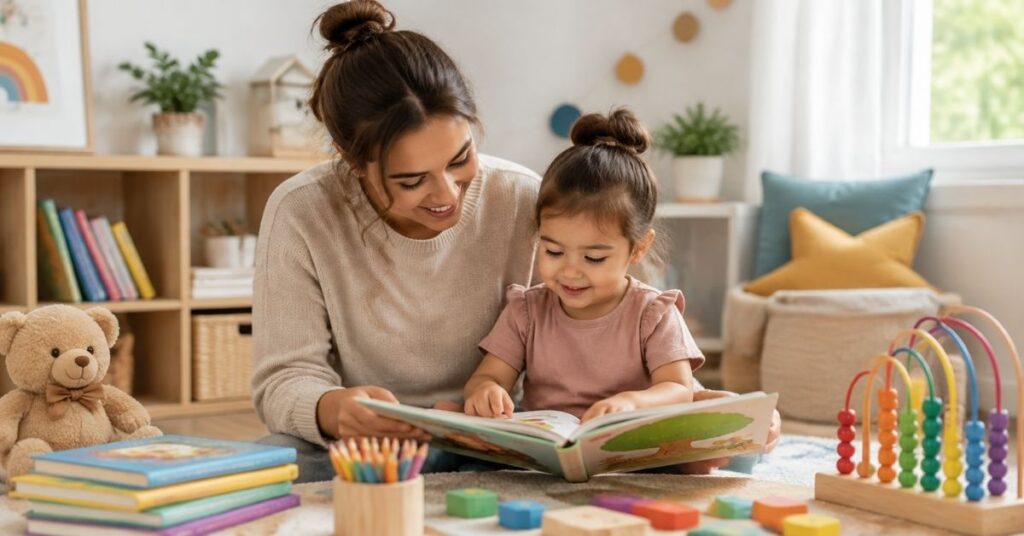
Reading aloud remains one of the easiest ways to create a language-rich environment, but the quality of the interaction matters.
Make books conversational
Suppose a picture book shows a character standing outside under dark clouds. Instead of immediately reading the next page, ask, What do you think might happen?
There is no need to question children after every sentence. Too many questions can turn a pleasant story into an assessment. A few natural comments are enough:
“That dog looks worried.”
“Have we ever seen a storm like this?”
“Why do you think she hid the key?”
These exchanges help children connect language, images, events and ideas.
Do not be afraid to reread favourites
Adults sometimes become tired of the same book long before children do. Repetition, however, lets children participate more actively.
After several readings, a child may supply the final word in a sentence, recognise repeated phrases, predict what appears on the next page or retell the story independently.
Singapore’s MOE Kindergarten home-reading programme also encourages children to bring English or Mother Tongue Language books home regularly, reinforcing the value of literacy experiences that continue beyond the classroom.
Introduce Letters and Sounds Through Play
Knowing letters is useful before kindergarten, but endless alphabet drilling is unnecessary.
Start with letters that already mean something to the child. Their own name is an obvious example. “S is for Siti” has an immediate personal connection that an unrelated flashcard may not.
- From there, families can explore sounds naturally.
- Try saying, “I can see something in the kitchen that starts with /m/. Can you find it?”
- Play rhyming games with simple words.
- Use magnetic letters to build names.
- Look for a particular letter while walking through a shopping centre.
- Clap the parts in familiar names.
The purpose is not to test how many letters a child can memorise. It is to help the child discover that spoken sounds and written symbols are connected.
RARE Learning’s curriculum philosophy similarly emphasises using varied tools, games and familiar interests to make early learning engaging rather than presenting every skill in the same way.

Support English and Mother Tongue as Living Languages
Early literacy in Singapore often develops within a multilingual environment. Children may hear English alongside Mandarin, Malay, Tamil or another home language. Parents do not need to turn bilingual development into two separate academic lessons.
Mother Tongue can live naturally through conversations with grandparents, songs, picture books, family stories, cultural celebrations, food, neighbourhood experiences and everyday routines. ECDA’s preschool resources also position Mother Tongue language development as a way for children to strengthen communication while connecting with cultural identity and heritage.
The important principle is meaningful exposure.
A child is more likely to see a language as useful when it helps them talk to someone they love, understand a story, sing a favourite song or participate in family life.
Use Digital Learning as a Tool, Not a Replacement for Interaction
Technology can support early literacy when children actively participate rather than simply watch.
An interactive story might invite a child to identify a sound, arrange events in sequence or choose what happens next. A word game could provide additional practice with letters a child is currently exploring.
The adult’s involvement makes the experience more valuable.
Ask what the child noticed. Connect a digital activity with something in the physical world. If a game introduces the word “bridge” look for bridges during the next journey outside or build one with blocks.
This approach also fits RARE Learning’s emphasis on combining learning tools with individual coaching and parental involvement rather than expecting technology to teach a young child independently.
Choose Preschool Literacy Experiences That Build Confidence
Parents evaluating a preschool or enrichment programme should look beyond how early children are expected to read.
A strong early literacy environment usually includes:
- Plenty of conversation, with educators giving children time to explain their ideas.
- Accessible books and storytelling, rather than books appearing only during formal lessons.
- Playful sound and letter activities that are suitable for the child’s developmental stage.
- Different ways to learn, including movement, stories, games, visuals, music and hands-on materials.
- Individual support, because children do not develop literacy skills at exactly the same pace.
Small-group and individualised literacy support are also used within Singapore’s preschool sector to address children’s different learning needs.
Parents should therefore ask more than, “Will my child learn to read?”
Better questions include, “How do you encourage children who are hesitant to speak?” “How do you introduce letter sounds?” and “What happens when one child progresses differently from the rest of the group?”
The answers reveal much more about the quality of the learning environment.
Avoid Turning Progress Into a Race
One of the biggest mistakes in early literacy is comparing children too closely.
One four-year-old may recognise dozens of words but struggle to retell a simple story. Another may recognise fewer printed words yet have an impressive vocabulary and tell detailed, imaginative stories.
Both children are developing important literacy abilities.
Parents can pay attention to progress without constantly testing it. Notice whether the child is becoming more interested in books, using new vocabulary, recognising familiar letters, listening to stories for longer, experimenting with writing or asking what words mean.
The aim before kindergarten is steady development, not a perfect checklist.
When parents and educators communicate regularly, they can also distinguish between normal differences in learning pace and areas where a child may benefit from additional support. Singapore provides targeted preschool support for children who need help in areas that can include speech, language and literacy.
Conclusion
The strongest early literacy preparation rarely looks like intensive academic preparation.
It looks like a child laughing at a rhyming book, asking what a sign says, telling a complicated story at dinner, recognising the first letter of their name, singing in a Mother Tongue language or pretending to write an order at a make-believe restaurant.
These experiences build the abilities that formal reading later depends on while protecting something equally important: the child’s willingness to learn.
Before kindergarten begins, parents and educators do not need to rush children towards advanced reading. They need to surround them with meaningful language, interesting stories, playful opportunities to explore sounds and print, and adults who respond to their curiosity.
When those foundations are strong, kindergarten becomes the next chapter in literacy development not the first page.
Frequently Asked Questions
Should my child be able to read before starting kindergarten?
No. Children enter kindergarten with different levels of reading ability. Focus on language, listening, vocabulary, stories, letter awareness and confidence rather than requiring independent reading too early.
How long should I read with my preschooler each day?
There is no perfect number of minutes. A short, enjoyable reading routine that happens consistently is more useful than forcing a long session when the child has lost interest.
Are alphabet worksheets necessary for early literacy?
No. Children can learn letters through names, books, signs, magnetic letters, drawing, games and everyday print. Worksheets can be one tool, but they should not dominate early learning.
Can learning two languages confuse a preschool child?
Using more than one language is a normal part of life for many Singapore families. Give children regular, meaningful opportunities to hear and use each language rather than treating language exposure purely as an academic exercise.
What is the most important thing parents can do before kindergarten?
Make language part of everyday life. Talk with your child, read together, answer questions, play with words and give them reasons to use language. Those habits provide a stronger literacy foundation than simply trying to move ahead of the school curriculum.