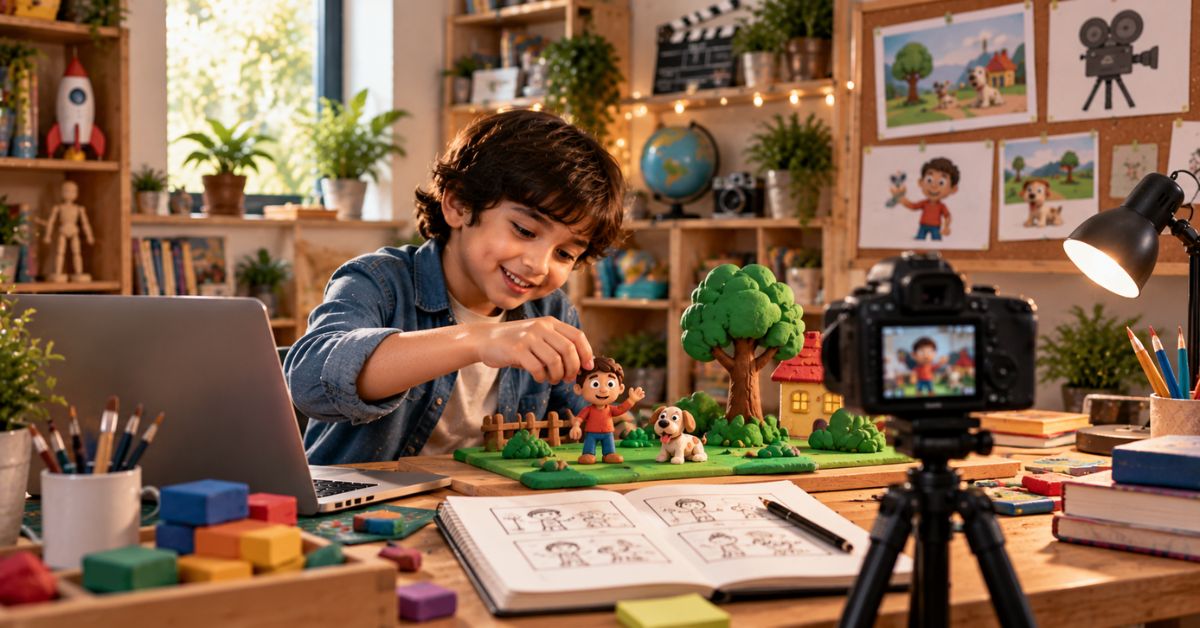
Kids learn storytelling and animation together when they turn an idea into a claymation film. Writing gives their characters a purpose. Storyboarding helps them decide what viewers need to see. Moving clay figures between photographs teaches them how timing changes an action or emotion.
The learning happens through decisions children can see on screen: whether a scene makes sense, whether a character looks surprised, and whether the ending answers the problem introduced at the start.
Turning an Idea Into a Short Script
A workable first film starts with a character who wants something and encounters an obstacle. Consider a robot delivering a birthday present. When it reaches a broken bridge, it must find another way across.
An instructor can help children develop that idea with questions: Why does the delivery matter? What does the robot try? How does its choice lead to the ending?
Answering those questions connects events through cause and effect. The robot spots a fallen branch, pushes it across the gap, and completes the delivery. Each action prepares the audience for the next.
Children then write the essential actions and any dialogue. Keeping the cast small and the setting manageable leaves time to animate the important moments. Choosing what to leave out becomes an early lesson in storytelling.
Using Storyboards to Plan What Viewers See
Storyboarding turns the script into a sequence of pictures. Simple sketches are enough; each panel needs to communicate an action, a camera view, or a change in the scene.
For the robot story a wide view could reveal the broken bridge. A closer view could show the robot looking down at the gap, followed by a shot of the branch it notices.
This planning exposes missing information before filming begins. If the branch suddenly appears beneath the robot, viewers may not understand the solution. Adding the discovery and placement makes the sequence readable. Children practice imagining what someone unfamiliar with their story will understand.
Building Clay Characters That Can Perform
Character design becomes practical when children test whether their models can carry out the script. A figure may look impressive but topple whenever an arm moves. Broad feet, a balanced body, and sturdy attachments can make repeated repositioning easier.
Children also explore how posture communicates personality. A robot leaning toward the broken bridge might seem curious; the same figure tilted backward could appear startled. Changing an eyebrow or lowering the head creates another possible reaction.
A useful exercise is to pose the character in two emotions without dialogue. If another camper can recognize the difference, the model is beginning to function as an actor.
Learning Movement and Timing One Frame at a Time
Animation practice starts with a short action, such as turning a head or sliding a gift across a table. Children move the object slightly, remove their hands, take a photograph, and repeat.
Playback makes timing visible. At a fixed playback rate, smaller movements across more photographs make the same journey take longer. Larger jumps between photographs make it faster and can look abrupt.
For example at 10 frames per second, 20 photographs produce two seconds of footage. That simple relationship helps children plan how long an action should last.
Timing also tells the story. The robot could hesitate before stepping onto its makeshift bridge, then hurry once it feels secure. A held pose gives viewers time to notice uncertainty. Children discover that believable animation depends on choosing movements that express an intention.
Keeping the Camera View and Lighting Consistent
Clear animation requires control over what stays still. Children learn to secure the camera, keep the background in place, and check that hands have left the shot before capturing another frame.
Consistent lighting matters because changing shadows or brightness can distract from the action. A quick check of the screen can reveal a sleeve blocking a lamp or a prop hiding the character’s face.
These habits connect technical care with storytelling. When the set shifts unexpectedly, viewers notice the filming process. When the image remains steady, they can follow the character’s choices.
Reviewing Footage and Making Purposeful Revisions
Watching an early sequence gives children something specific to improve. A character might cross the screen too quickly, or an important reaction might disappear before viewers register it.
Useful feedback names the moment: “I couldn’t tell when the robot noticed the branch.” Children can then adjust a pause, add a missing shot, or reshoot an unclear action.
Where a camp includes sound work, a creaking bridge or a short gasp offers another way to communicate tension. Narration can supply information that is difficult to show, but it should leave room for the images to tell the story.
Revision teaches children to judge a creative choice by its effect on the audience.
Coordinating Roles During Production
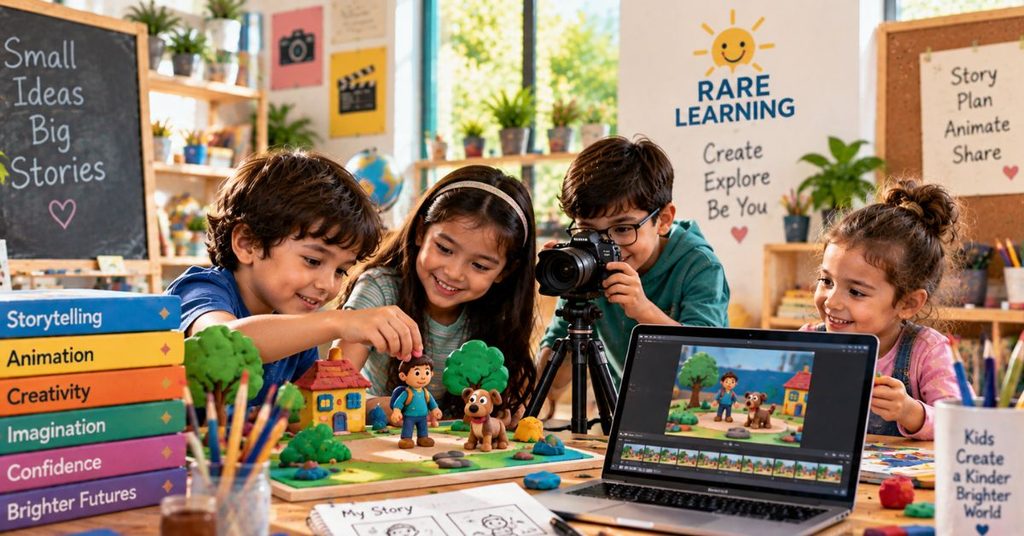
In group projects, children must agree on what happens before anyone moves a model. One camper might position the character while another captures frames and a third checks the storyboard.
Rotating these responsibilities gives each child a chance to understand how the production fits together. It also makes communication concrete: “Move the hand toward the present” is more useful than “Make it better.
When ideas compete, the group can return to the scene’s purpose. Which choice makes the character’s goal easier to understand? That question keeps collaboration focused on the film.
Putting These Skills Into Practice at RARE Learning
RARE Learning’s Claymation Creations camp introduces students to claymation through character making, scriptwriting, storyboarding, and producing an animated short film. Necessary clay materials are provided, and the summer camp page lists programs for ages 9–15.
Families can review the listed sessions and contact RARE Learning with questions about equipment requirements or how a session accommodates their child’s experience.
Frequently Asked Questions
Does a child need animation experience before camp?
An introductory camp can be a starting point for beginners. RARE Learning describes Claymation Creations as an introduction to the process; families should confirm any session requirements before registering.
Do children need to be good at drawing?
Detailed drawing is unnecessary for a useful storyboard. Stick figures, arrows, and brief notes can show where characters move and what happens in each shot.
Is claymation camp mostly screen time?
The process combines physical making with digital work. Children shape models and plan scenes away from the screen, then use a device to capture and review their animation. The balance varies by program.
How long should a beginner animation be?
A complete scene lasting a few seconds can be a productive first exercise. For a finished story, length should match the available time and the child’s experience; clarity matters more than runtime.