

Junior Newsroom summer camps help kids build journalism skills by giving them a story to report and an audience to inform. Preparing a news segment means deciding what matters, asking useful questions, organizing information, and explaining it clearly. With guidance and opportunities to improve their work, children can experience the decisions behind a credible report.
RARE Learning’s Junior Newsroom summer camp brings that experience into video journalism. Participants develop a news bulletin with a professional instructor while practicing storytelling, interviewing, and presentation. Here is how that kind of project can support real reporting skills, with examples of exercises that make the learning meaningful.
Turning Curiosity Into a Reportable Story
A workable story starts with a focused question. “Our recreation center” is a broad subject. “How does the recreation center choose its summer activities?” gives a young reporter something specific to investigate.
An instructor can help children narrow an idea by asking who the story affects, what has changed, and what viewers would want to know. Kids then identify the people or information that could help answer those questions.
This process develops news judgment: choosing details because they matter to an audience. For example, a report about a new playground might explain which features younger children can use and when it opens. Those details give the story a clear purpose and make it useful to local families.
Asking Better Questions and Listening to Answers
Interviewing turns curiosity into a conversation with someone who knows the subject. Children can prepare by learning a little about that person and writing questions that invite explanation.
For a practice interview with an activity leader, useful questions might include:
- What do beginners find most challenging?
- How do you help someone who gets stuck?
- Can you describe a moment when the group solved a problem together?
The next skill is listening closely enough to ask a follow-up. If the leader mentions changing an activity, a camper might ask what prompted that change.
Keeping accurate notes, checking the spelling of a name, and confirming what an unfamiliar word means all strengthen the reporting. Children learn that a good interview depends on understanding the answer before moving to the next question.
Checking Facts Before Recording
Reporting gives children a practical reason to check information. Before presenting a statement as fact, a young journalist should be able to explain where it came from and how it was checked.
In a camp exercise, students could verify an event’s time against an official schedule and confirm a change with the organizer. If two sources disagree, the next step is to investigate the difference before recording the script.
An instructor can also help separate observation from opinion. “Twelve children joined the activity” is a checkable statement. “It was the best activity all summer” expresses a judgment.
These habits give kids a useful way to evaluate information they encounter elsewhere: identify the source, look for evidence, and notice what remains uncertain. A convincing delivery should never substitute for a supported claim.
Writing Scripts That Make Sense When Spoken
Video reporting makes writing immediately testable. When a child reads a script aloud, long sentences, missing explanations, and awkward wording become easier to notice.
A simple news script can open with the main development, explain the essential details, and include a relevant interview comment. The reporter needs to answer the audience’s likely questions without crowding every fact into the first sentence.
For a practice report about a community cleanup, the opening could explain what volunteers accomplished. Later lines could describe where they worked and what happens next.
Reading the draft to a partner adds another check: can someone unfamiliar with the story follow it? Revising around that listener’s questions teaches children to write for an audience. They also practice introducing a source clearly so viewers understand whose information they are hearing.
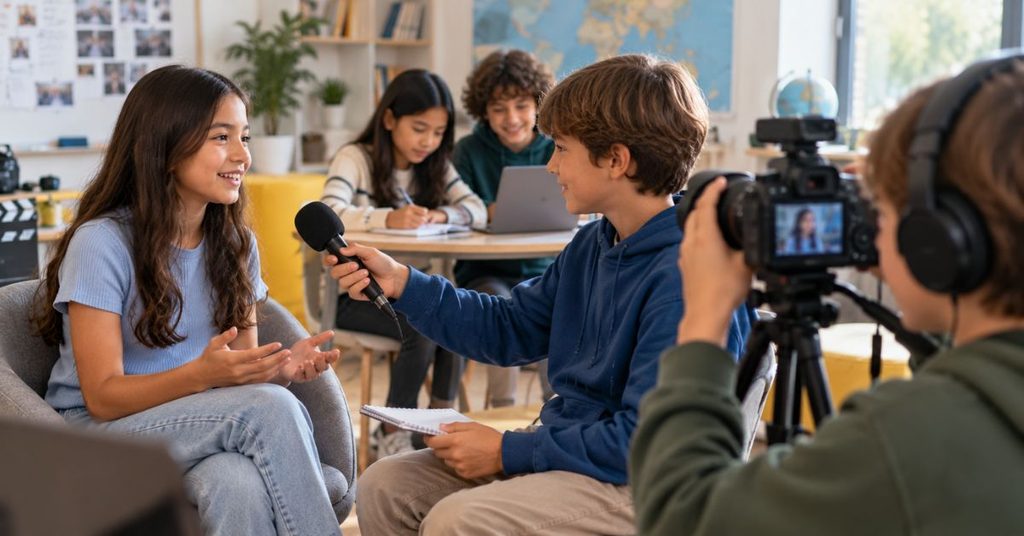
Making Clear Choices on Camera
Presenting a segment gives children specific communication skills to rehearse. They can work on speaking at an understandable pace, pronouncing names correctly, and pausing between ideas. A useful practice routine is to record a short passage, identify one improvement, and try again.
Visual choices matter too. In a sample gardening report, a close view of seedlings could explain what volunteers planted, while a wider view could establish the location. Each image should help viewers understand the story.
This also creates opportunities to discuss responsible presentation. Children should understand why footage needs accurate context, why a staged scene should be identified, and why an interview clip must preserve the speaker’s meaning. Those decisions connect the creative side of video with the responsibility of reporting.
Working Toward a Shared Deadline
A group bulletin gives individual assignments a shared destination. One segment may need an introduction, another may need a shorter script, and everyone needs enough time to prepare material for the finished program.
With clear responsibilities and manageable checkpoints, campers can practice planning backward from a deadline. They learn to communicate when something is missing and to adjust their work when a teammate needs clarification.
Feedback becomes more useful when it names a specific problem. “Explain who this person is” gives a reporter an action to take. “Make it better” does not. Learning to give and use precise feedback helps children contribute to a newsroom and strengthens their approach to future group assignments.
Connecting the Segments in a Finished Bulletin
RARE Learning describes a bulletin that includes anchoring, breaking news, investigative reporting, entertainment, and weather. These formats create different communication challenges, from introducing the next story to explaining information concisely.
The instructor compiles the segments at the end of camp so participants can watch the complete bulletin. That finished program offers a concrete opportunity for reflection: what did the audience learn, which explanation worked, and what would the reporter improve next time?
Parents can ask how feedback and reporting exercises are incorporated when requesting Junior Newsroom program information.
FAQs
What ages are RARE Learning’s summer camps designed for?
RARE Learning advertises its summer camps for ages 9–15. Confirm the requirements for your selected Junior Newsroom session before enrolling.
Does my child need previous journalism experience?
The camp description does not list a prior journalism requirement. Ask about beginner support and the reading or writing expectations for the group.
Can a shy child benefit from a newsroom camp?
Yes, with appropriate support. Preparing questions and rehearsing short passages can offer manageable practice. Ask how instructors support children who feel nervous about presenting.
Will children edit the final video themselves?
RARE Learning states that the instructor compiles the bulletin. Families interested in student editing instruction should ask what the selected session includes.