Walk through the educational toys aisle at any big store and the message is hard to miss: your three-year-old should already be coding, memorizing sight words, and racing through math flashcards. A lot of parents feel that pressure and start to worry their child is behind before kindergarten has even started.
That pressure gets something important wrong. The years before five are exactly when children are most curious about how the world works and what we do with that curiosity matters far more than any worksheet. Good STEM learning at this age isn’t early academics in a lab coat. It’s the groundwork for how a child will approach every hard, unfamiliar problem they run into later, whether that turns out to be a quadratic equation or a broken dryer.
What counts as STEM at age three or four
When people hear STEM they usually picture screens, robots, and coding apps. For a preschooler, that picture is mostly wrong, and chasing it can get in the way of the real thing.
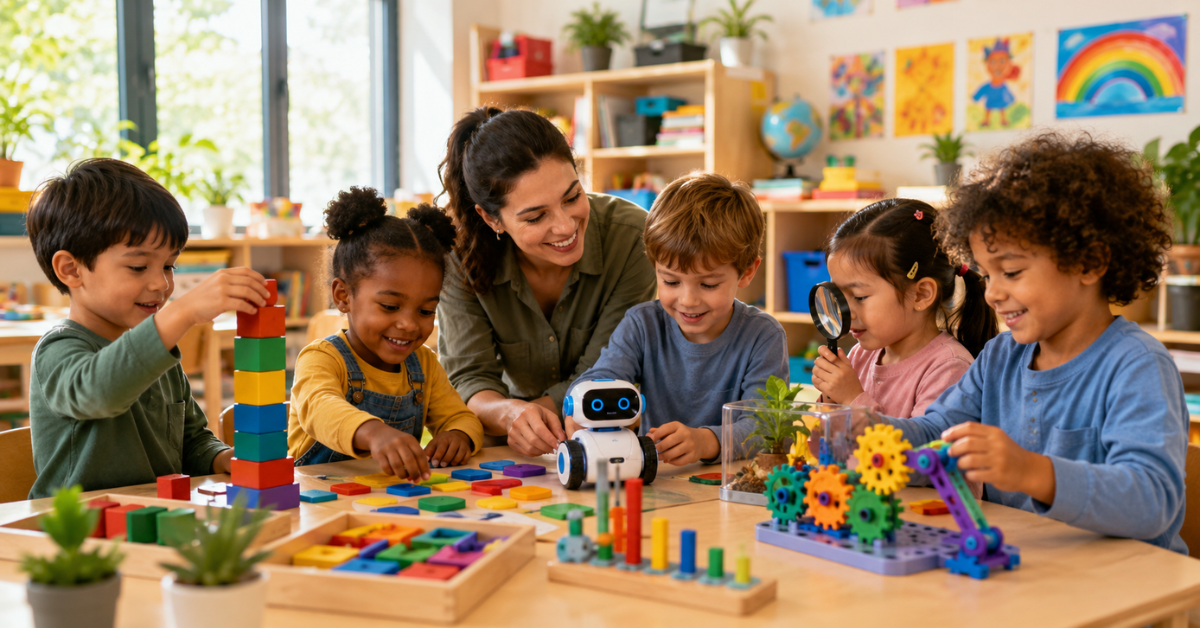
A four-year-old stacking blocks higher and higher until the tower topples is running a physics experiment. She’s testing balance, weight, and gravity, and collecting a fresh result every time it falls. A child at the water table working out which cup holds more, or why the plastic boat floats while the rock sinks, is doing the same work. No app, no right answer printed on a card. Just a small person trying to figure out a rule about how things behave.
At this age the four letters blur into a single activity: making sense of how the world works. Noticing is the science. Counting the blocks and comparing the towers is the math. Building the thing and rebuilding it after it collapses is the engineering. Technology, at four, just means using a tool to get a closer look, a magnifying glass over a beetle or a measuring cup at the sink. Splitting them apart is useful for adults planning a program. For the child, it’s all play.
You’re probably already doing this at home
Some of the richest STEM moments happen in the kitchen and the backyard, with nothing bought for the purpose.
Baking is full of them. Measuring flour teaches quantity and fractions long before those words mean anything. Watching batter turn into muffins is a first lesson in how heat changes things, chemistry a child can eat. Doubling a recipe is multiplication with real stakes, because getting it wrong means half the cookies.
Outside is the same. A child who notices the puddle is smaller today than it was yesterday is watching evaporation happen. One who lines up rocks from biggest to smallest is sorting, which is where data begins. A garden stretches cause and effect over weeks: you planted, you watered, and something grew, or didn’t, and the child starts wondering why.
You don’t need to turn every snack into a lesson. The raw material for this kind of thinking is already in your kitchen and your yard.
The skills that outlast the facts
Ask a room of adults what they remember from preschool and almost nobody names a fact. What sticks is harder to write on a report card, and it’s exactly what STEM play in these years quietly builds.
Start with persistence, which might be the most valuable of the lot. A block tower that falls eleven times and gets rebuilt a twelfth teaches a child that failure is information rather than a verdict. Being able to be wrong and keep going is worth more over a lifetime than any early reading milestone, and it’s painfully hard to teach later if a child never got comfortable with it early.
Spatial reasoning grows the same way. Kids who spend a lot of time building, fitting shapes together, and picturing how pieces go tend to find math easier down the road, geometry especially, but also the abstract material that trips people up in high school. You can’t cram spatial sense the night before a test. It builds slowly, through hands and blocks and puzzles over years.
There’s also the plain language of reasoning. More, less, before, after, same, different, if, because, these are the words logic is made of. A child who hears and uses them constantly while sorting buttons or guessing what comes next is wiring the grammar of problem-solving into the way they think.
Under all of it sits executive function: holding a goal in mind, making a plan, and sticking with it when the work gets fiddly. Building a marble run that carries the marble all the way to the end demands exactly that. It’s the same muscle a teenager leans on to study for finals and an adult uses to finish anything hard.
Why this isn’t career preparation
There’s a temptation to sell all this as building tomorrow’s scientists and engineers. Some of these children will grow up to be exactly that. Most won’t, and that’s fine, because that was never the real reason to do it.
Nobody knows what jobs will exist in twenty years. Plenty of today’s work didn’t exist when today’s parents were in school. Betting a child’s early years on memorizing a fixed set of facts is a weak wager when you can’t see the board. What holds its value in any future is the disposition underneath it all: the willingness to look at something confusing and unfamiliar and think “let me work this out” instead of freezing. That habit carries into law, plumbing, medicine, parenting, whatever the world throws up next. Preschool STEM is one of the best ways we know to grow it.
How early play keeps kids from deciding they’re bad at math
Somewhere around late elementary school, a surprising number of children quietly decide they’re “not a math person.” Once that belief takes hold, it’s stubborn. They stop trying, steer around the subject, and the gap widens because they’ve opted out of the practice that would close it.
What’s easy to miss is how early the seeds get planted. When math first shows up as something to be tested on, with right and wrong answers and a little pressure attached, some kids learn to link it with the feeling of maybe being wrong in front of everyone. That feeling, far more than any shortage of ability, is what pushes them away.
Preschool STEM done as play sidesteps almost all of it. When a child spends years meeting quantity, pattern, and logic as fun, math never gets filed under “scary thing I might fail.” By the time the formal version arrives, it feels like an old friend instead of a stranger with a clipboard. The confidence was built quietly, years before anyone called it math.
I come back to this one a lot, because it’s so preventable. You can’t easily talk a ten-year-old out of math anxiety once it’s set. But you can make sure it never forms, and that work happens at three and four, in ways that look nothing like studying.
The words adults use are the real curriculum
Something that surprises a lot of parents: the most powerful STEM tool in your house isn’t a toy. It’s the way you talk.
Say your child asks why the moon is out during the day. You can answer, or you can hand the question back: “Huh, why do you think it’s still up there?” The second response turns a dead-end fact into an investigation. Do that across a thousand small moments and a child learns that questions are doors, not things adults close on your behalf.
You don’t need a script. A few habits do most of the work:
- Ask “what do you think will happen?” before you do the thing, whether that’s dropping an object or stirring two colors together. The guess is where the thinking lives.
- When something surprises them, hold off on explaining. “That’s strange, isn’t it? Why do you think that happened?” keeps the wondering alive a little longer.
- Say cause and effect out loud. “The ice is melting because the room is warm.” Children absorb this kind of language and start producing it themselves.
- Sprinkle comparing words through ordinary play. More, less, heavier, lighter, faster, slower, used casually, makes quantity feel natural rather than school-ish.
- Let “I don’t know, let’s find out” be an ordinary thing to say. It teaches that not knowing is a beginning, not something to be embarrassed about.
None of this asks for special time or a single purchase. It’s a way of being in conversation with a small person who’s working hard to make sense of everything around them.
What real STEM learning looks like in a preschool
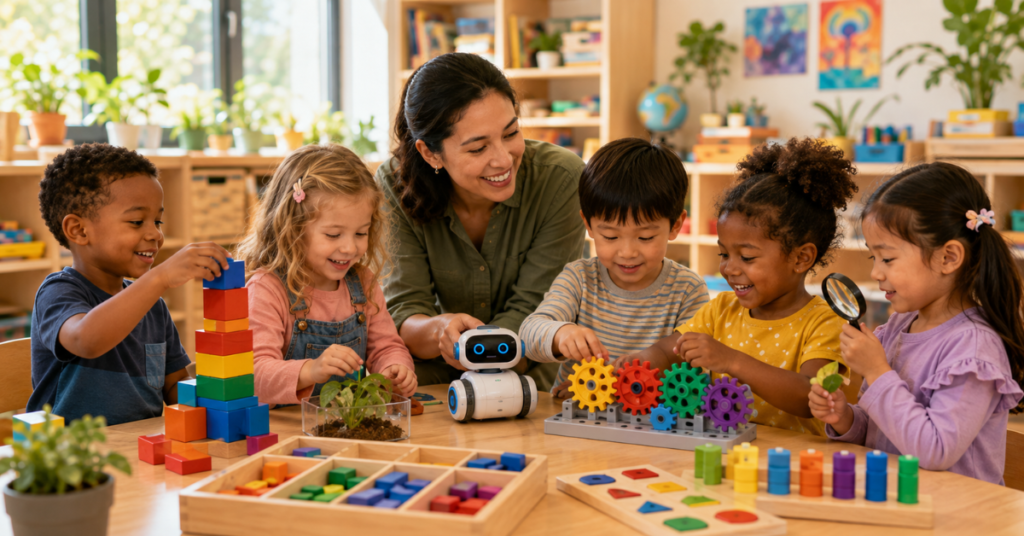
Because “STEM” sells, plenty of programs stick the label on things that don’t earn it. A cart of tablets running flashy apps and a shelf of branded gadgets can look impressive on a tour and teach a child almost nothing. It helps to know what the real thing looks like from the outside.
Signs a program is doing this well:
- Children get long stretches with open-ended materials like blocks, water, sand, ramps, and loose parts, and room to chase their own ideas with them.
- The adults ask more than they answer, and they let kids wrestle with something for a while before stepping in.
- Mess and trial and error are welcome, not hurried along to a tidy right answer.
- Screens are rare or absent, and any tools children use are the kind they hold in their hands.
- The schedule has unhurried blocks of time, because real exploration can’t happen in ten-minute rotations.
If a program’s STEM pitch leans mostly on devices, apps, and worksheets that send home a neat finished product, stay a little skeptical. The good version is usually quieter and, to an untrained eye, looks a lot like regular play. That’s the whole idea. It is regular play, set up on purpose and supported by adults who understand what’s going on underneath it.
Making sure every child gets the same start
One uncomfortable truth about early STEM: children don’t all get equal access to it, and the split starts young. Building toys, construction sets, and “let’s figure out how this works” encouragement still land more often with some kids than others, sometimes following old assumptions about who’s supposed to enjoy that sort of thing. A child who logs hundreds of hours building and taking things apart shows up to school with an edge in spatial thinking that has nothing to do with talent. It’s practice, plain and simple.
A strong early program flattens that on purpose. Every child gets time in the block corner and at the water table. Every child gets asked what they think will happen, and gets to test the guess. When that early confidence is handed out evenly, fewer children reach formal school already convinced that math and science belong to other people. That early edge, or the absence of it, has a way of echoing for years.
The groundwork you won’t see on a report card
The things that matter most here never show up on a preschool progress sheet. There’s no line for “keeps trying after the tower falls” or “asks sharp questions about why things happen.” Yet those are the exact capacities that will still be paying off when your child is twenty-five and staring at a problem nobody trained them for.
The world these kids are walking into will keep shifting. The specific tools and facts will date quickly. What won’t date is a mind that meets the unfamiliar with curiosity instead of fear, treats being wrong as a step instead of a dead end, and trusts itself to work things out. That kind of thinking gets built before the age of five, through play that looks nothing like school.
Which is why drilling facts into a three-year-old has it backwards. The most future-ready thing you can offer is to protect the play, stay curious right alongside them, and trust that a child puzzling over why the boat floats is doing the work that lasts.
Frequently asked questions
When can STEM learning start?
It’s already underway. A baby dropping a spoon to watch it fall is testing cause and effect. By two or three, children are full-time investigators, so there’s no starting line to wait for. What grows with age is the complexity of what they can take on, not whether they’re ready.
Does my child need special toys or technology?
No. Some of the best STEM learning runs on blocks, water, measuring cups, and whatever’s out in the yard. Screens and branded gadgets are optional at best and often a distraction this young. Your attention and your questions do far more than any product on a shelf.
Isn’t preschool too early for real math and science?
It’s early for formal instruction, not for the thinking underneath it. Sorting, comparing, counting, predicting, and building are math and science in their earliest form. Meeting them as play now is what makes the formal version feel manageable later on.
How is this different from ordinary play?
Mostly it isn’t, and that’s the point. The difference is intention. An adult who asks the right question at the right moment, or sets out materials that invite testing, turns everyday play into something a child learns from without it ever feeling like a lesson.
What if my child isn’t interested in building or numbers?
Follow whatever they do love. A child obsessed with dinosaurs is ready to classify, compare sizes, and ask what happened to them. One who loves helping cook is measuring and watching things change. STEM thinking isn’t locked to blocks or number sheets; it clips onto whatever already holds their attention.